From Near-Cancellation to Production Contract
ARRW's path to production is worth understanding because it illustrates the specific structural challenge facing any hypersonic program that needs to move fast but still answer to an annual appropriations cycle.
In March 2023, the Air Force proposed eliminating ARRW procurement from the FY2024 budget, citing test results and a desire to redirect investment toward HACM — the Hypersonic Attack Cruise Missile, a scramjet-powered alternative built by Raytheon. The Air Force dropped procurement again in its FY2025 request. It then returned with a FY2026 procurement request; Congress provided $362.2M in FY2026 procurement funding. Testing continued through 2023 and 2024; on March 17, 2024, a B-52H departed Andersen AFB, Guam, and released a live ARRW round at the Reagan Test Site — the last planned prototype test at that stage, per Breaking Defense. The Air Force did not publicly characterize the test outcome.
The $694M contract announced October 26, 2026 is the result of that sustained testing path and the Air Force's resumed procurement investment: formal entry into production through the EWAAC vehicle.
What ARRW Is and What It Is Not
ARRW is a boost-glide system, not a scramjet. The distinction matters for understanding both its operational profile and its competition with HACM.
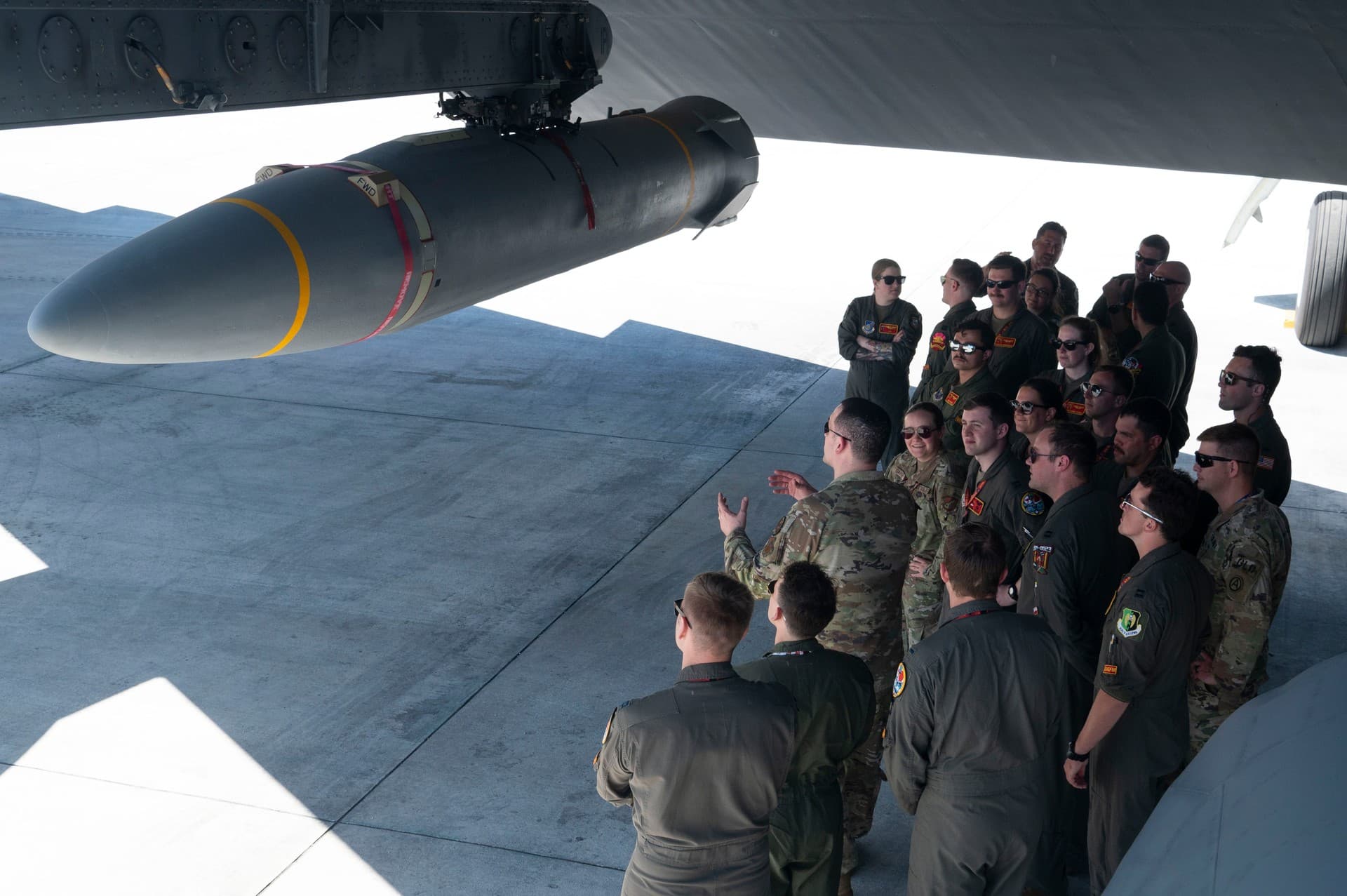
The weapon uses a solid-fuel rocket booster to reach hypersonic speeds, then releases an unpowered hypersonic glide vehicle that maneuvers toward the target. Boost-glide is a relatively mature concept — the physics are well understood, and the manufacturing challenge is primarily about thermal protection, guidance accuracy at extreme speeds, and integration with legacy bomber platforms. The B-52H is the primary platform; B-1B integration has been reported, with The War Zone reporting Edwards AFB imagery of a Lancer carrying an ARRW test article in spring 2026. Range is approximately 1,000 miles (roughly 1,600 km), which translates to meaningful standoff from defended airspace.
HACM, by contrast, uses a scramjet engine that sustains thrust throughout the hypersonic flight envelope. That gives it different flight characteristics but introduces significantly more manufacturing and reliability complexity — scramjets have no rotating machinery but must sustain air-breathing combustion at hypersonic speeds across an extreme thermal envelope throughout the flight profile. The Air Force confirmed on October 6, 2026 that a first release test had occurred over an Australian range; it did not disclose the test date, platform, method or results, per Air & Space Forces Magazine. The Air Force's FY2026 RDT&E request for HACM was $802.8M; the FY2027 weapons document indicates HACM is expected to transition to a major defense acquisition program with an initial production decision in FY2027.
The two weapons are complements, not substitutes. The FY2027 Program Acquisition Costs document describes ARRW as the longer-range weapon. HACM's sustained-thrust scramjet may offer different flight profiles suited to distinct mission sets. The Air Force having both in development and production is a more resilient posture than concentrating on the more technically demanding option alone.
A credible alternative — relevant if Increment 2 funding collapses — is to accept that ARRW remains a fixed-target weapon and rely on other systems for moving-target engagement. That approach would simplify the depot and support footprint for ARRW and concentrate development resources on HACM. It makes sense if Increment 2 development runs significantly behind schedule or if the Air Force concludes that fixed-target strike justifies the production investment on its own. The Air Force has not signaled that posture, but the FY2027 appropriations outcome will indicate whether Congress accepts it.
Increment 2: The Moving-Target Question
The most operationally significant aspect of the ARRW roadmap is not the production contract itself — it is the Increment 2 work requested under the FY2027 PDI budget line, which adds a terminal seeker and a data link to the existing boost-glide body.
Without a terminal seeker, ARRW is effective against fixed, pre-surveyed targets: hardened facilities, command infrastructure, airfields. That covers a meaningful target set, but it leaves out one of the highest-value target categories in a Pacific scenario: surface combatants.
Adding a terminal seeker would, in principle, enable the weapon to acquire and track a moving vessel through terminal guidance rather than relying on a pre-surveyed GPS coordinate. The data link would allow updated targeting data to be transmitted mid-flight — relevant given the time-of-flight gap between a B-52H launching outside defended airspace and the weapon reaching target range.
The FY2027 Pacific Deterrence Initiative display lists PE 0604033F at approximately $296.3M, with the line covering cost-reduction and development work across ARRW Increment 2 and other hypersonic programs. PDI is Congress's designated mechanism for funding capabilities sized for the Western Pacific; its placement in that section signals intended use, not just geography. However, the FY2027 budget is currently operating under a continuing resolution (P.L. 119-103) through December 11, 2026 that generally bars new program starts — and Increment 2 is a new start beginning in FY2027. Full FY2027 funding requires an enacted appropriations bill, likely not until early 2027 at the earliest.
Industrial Base: Troy, Alabama
The production contract is accompanied by a facility expansion at Lockheed Martin's Building P-20 in Troy, Alabama. Lockheed broke ground on October 27, 2026, on a 47,000-square-foot addition that triples production space, per the Lockheed release.
What this signals, in this analyst's reading: hypersonic programs that have struggled in the past often treated production as a future problem. Here, Lockheed invested $67M in facility preparation before the contract award; the four years of workforce expansion begins from the October 27 groundbreaking. That sequencing — investment preceding rather than following contract — suggests both sides are treating ARRW as a sustained production program. Whether it follows through depends on congressional action in FY2027 and beyond.
Strategic Context: Quotes from Service Leadership
Secretary of the Air Force Troy Meink said in the October 26 Air Force release: "This is a turning point in our advanced weapons roadmap." Air Force Chief of Staff Gen. Ken Wilsbach stated: "Fielding ARRW enhances our ability to hold targets at risk anywhere around the world."
The framing from leadership is consistent across these statements: ARRW is not positioned as an experimental capability or a technology demonstration. The program is being treated as a production weapon system, with the production contract and facility investment backing that posture.
What to Watch
Increment 2 funding decision (owner: Congress — Senate and House defense appropriations subcommittees). Increment 2 is a new start within the FY2027 PDI budget line (PE 0604033F), currently blocked by the continuing resolution running through December 11, 2026. An enacted FY2027 appropriations bill is required before the work can begin. Given ARRW's FY2024–2025 procurement gaps, that outcome is not guaranteed. Subcommittee markup language and the timing of any appropriations bill will be the earliest signals of congressional intent.
B-1B integration (owner: AFLCMC, 412th Test Wing). Reporting through April and May 2026 noted the first public imagery of a B-1B Lancer carrying an ARRW test article, suggesting integration work is active. The Air Force has not announced a timeline or milestone schedule. In this analyst's assessment, B-1B integration would expand forward basing options; the aircraft's different stores management system and airframe geometry are likely to introduce integration work beyond what the B-52 program required. Watch for Edwards AFB flight-test activity and any Air Force flight-test contract awards for Lancer-ARRW integration.
HACM first production decision (owner: Air Force milestone decision authority). The FY2027 weapons document positions HACM for a major defense acquisition program transition and initial production decision in FY2027 — a distinct milestone from fielding. Whether HACM and ARRW will share depot infrastructure or support concepts has not been publicly addressed, and that question will compound as both programs scale.
PDI funding continuity for ARRW Increment 2 (owner: Office of the Secretary of War, Pacific priorities). The Increment 2 PDI line (PE 0604033F) is an annual decision. If PDI is reduced or restructured in the FY2028 topline, Increment 2 development pacing is the most direct casualty. What would change this assessment: a FY2028 budget request that moves Increment 2 out of PDI and into the base Air Force RDT&E budget, signaling enough institutional support that it no longer needs the supplemental funding structure; or, conversely, a budget request that omits it entirely. The December 11 continuing resolution deadline is the first near-term signal: whether Congress enacts FY2027 appropriations in time to lift the new-start bar before the end of calendar 2026.
Sources and further reading
- U.S. Air Force, "DAF awards ARRW production contract, establishes new hypersonic capabilities," October 26, 2026: af.mil/News/Article-Display/Article/4633841/
- Lockheed Martin, "Lockheed Martin to Add Air-Launched Hypersonic Missile to the American Arsenal of Freedom," October 27, 2026: news.lockheedmartin.com
- Department of War Comptroller, FY2027 Program Acquisition Costs by Weapon System: comptroller.war.gov
- Department of War Comptroller, FY2027 Pacific Deterrence Initiative display: comptroller.war.gov
- DVIDS, Andersen AFB hypersonic weapon familiarization training, February 27, 2024: dvidshub.net/image/8270163
- Congressional Research Service, *Hypersonic Weapons: Background and Issues for Congress* (R45811): congress.gov/crs-product/R45811
- Eglin AFB, "Innovative contract method speeds up weapons procurement" (EWAAC overview): eglin.af.mil
- Department of War Comptroller, FY2026 Program Acquisition Costs by Weapon System (HACM $802.8M): comptroller.war.gov
- Breaking Defense, "Broken ARRW: Air Force to ditch troubled hypersonic missile," March 2023: breakingdefense.com
- Breaking Defense, "Air Force conducts final test of ARRW hypersonic missile, won't discuss specific results," March 2024: breakingdefense.com
- The War Zone, "B-1B Seen Carrying ARRW Hypersonic Missile For The First Time," spring 2026: twz.com
- The War Zone, "USAF Orders ARRW Hypersonic Missile Into Production," October 26, 2026: twz.com
- Air & Space Forces Magazine, "Air Force's Hypersonic Attack Cruise Missile Has First Flight Test," October 6, 2026: airandspaceforces.com
Tracking two concurrent hypersonic production programs — milestones, Increment dependencies, platform integration, industrial base readiness — against a volatile appropriations calendar is exactly the kind of multi-program complexity where Spartan X's program execution and acquisition support practice operates. Arbiter, Spartan X's AI assurance program currently in development, addresses a distinct but related challenge: assessing AI systems for drift, hallucination and error in the complex operational environments where these programs ultimately deploy.