The response is becoming more layered
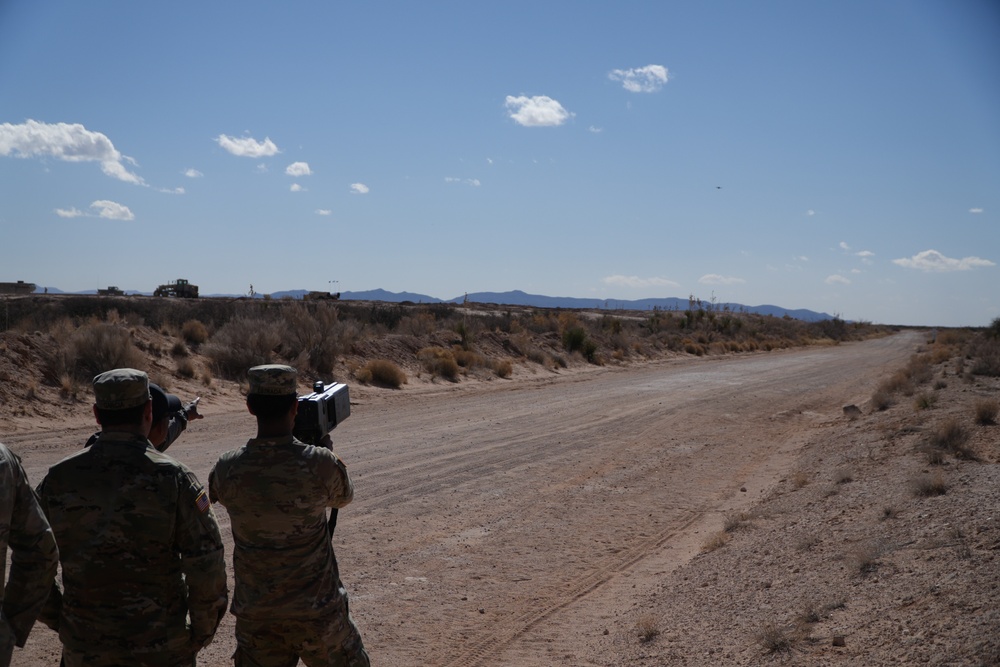
Small drones create difficult combinations of low signatures, clutter, maneuver, and volume. Different threats can require different sensors and responses. A solution that performs well against a known aircraft in a clear test environment may struggle with an unfamiliar target, crowded airspace, or conflicting observations.
The department’s August 2025 JIATF 401 establishment direction sought better alignment of authorities and resources for counter-small-UAS capability. Industrial and allied testing activity provides further evidence of the priority.
On March 24, 2026, L3Harris announced high-volume VAMPIRE production in Huntsville. The supplier described a flexible assembly and testing line supporting ground-vehicle and containerized installations. Separately, NATO reported its Latvian Innovation Range’s first UAS and counter-UAS testing campaign, held March 9–13, with companies, operational users, and government representatives.
Production and testing are complementary. More available systems can address demand, while shared evaluation helps establish what those systems can do together and under which conditions. Neither an industrial announcement nor a test event establishes universal coverage against the changing threat.
What an airborne layer could add
In a release with a March 31 dateline, Honeywell and Odys Aviation announced work to integrate SAMURAI with the Laila hybrid VTOL aircraft. Honeywell described it as the planned first airborne application of SAMURAI, following joint development and integration work.
The company cited up to eight hours of flight and a 450-mile range for Laila, with fuel compatibility that avoids dedicated charging infrastructure. Those are platform claims, not a demonstrated counter-drone engagement radius or guaranteed endurance with every payload and mission profile. The announcement describes a development direction, rather than a completed operational deployment.
An elevated sensor can change visibility around terrain and structures and can reposition as coverage needs change. It also introduces tradeoffs: weather, airspace coordination, payload power, endurance, communications, and its own vulnerability. Looking down does not eliminate clutter or identification problems.
A useful design study should compare the airborne option with ground and other available coverage. The relevant measure is how much dependable warning and response opportunity it adds to the protected mission.
Allocate the response time across the whole chain
Decision speed matters because a close contact may leave little time. As a simple illustration, an object closing directly from 800 meters at 50 knots covers that distance in about 31 seconds. This calculation is not a measured engagement timeline; detection, tracking, identification, authorization, and effect delivery all consume part of the available interval.
Reducing processing latency helps only if the output remains trustworthy. Detection itself is not a solved problem in every environment. Poor sensor placement, weather, low signatures, or interference may limit the evidence available before any AI model is involved.
The system design should account for:
- Detection and tracking: when the contact becomes observable and how reliably its motion is maintained.
- Identification: what evidence distinguishes a threat from authorized or benign activity.
- Prioritization: how urgency, uncertainty, and the protected mission shape operator attention.
- Authority: who may authorize an effect and what information supports that decision.
- Response: which available measure is suitable, lawful, and practical for the situation.
- Assessment: how the team determines whether the response worked and what to do next.
A ranked queue can reduce workload, but ranking does not confer authority or remove the need to understand uncertainty. Operators should be able to recognize contradictory evidence, changed conditions, and the limits of the recommendation.
Put essential functions where the mission needs them
If a deployment must operate through interrupted communications, the required local functions must be identified and tested. Local processing can support sensor fusion, tracking, or prioritization without waiting for a remote service. Connected resources may still support training, updates, or broader coordination when available.
The aircraft or ground node must balance compute against power, cooling, weight, and endurance. A model that meets a latency target on a laboratory workstation may behave differently on the operational hardware. Integration tests should use the intended sensors, deployment package, and data flow.
Lost connectivity also changes information quality. The operator needs to know which tracks are local, which reports are stale, and which permissions or instructions remain valid. The fallback should preserve the mission’s safety and authority boundaries rather than assume every function can continue unchanged.
Test the decisions, not just the detector
An effective evaluation measures how the combined system and operator perform. It includes unfamiliar signatures, ambiguous contacts, degraded sensors, competing alerts, and interruptions to supporting services. It should record both missed threats and inappropriate recommendations, with consequences relevant to the mission.
A practical acceptance plan can proceed in five steps:
- Define the protected mission, operating environment, permitted effects, and authority structure.
- Establish representative threat and benign-contact scenarios with measurable outcomes.
- Evaluate sensor and model performance on the actual deployment hardware.
- Exercise the operator workflow, including uncertainty, overload, intervention, and fallback.
- Preserve configuration and event records, then repeat the relevant tests after material changes.
Explainability can help users interpret a recommendation, but a confident narrative is not evidence of a correct classification. Independent evaluation, observable performance, and well-designed human interfaces provide a stronger basis for trust.
Layered counter-UAS defense will continue to evolve as sensors, aircraft, software, and effects improve. The enduring requirement is to make the complete decision loop fast enough, reliable enough, and sufficiently accountable for the environment in which it will be used.
Sources and further reading
- Departmental direction establishing JIATF 401
- L3Harris: VAMPIRE production announcement
- NATO: Latvian Innovation Range testing campaign
- Honeywell: SAMURAI and Laila integration announcement
Spartan X’s AI, cybersecurity, and integration expertise connects sensor evidence with the operational decisions it must support. For counter-UAS, that means testing the deployed workflow, preserving authority and uncertainty, and making edge capability dependable under the conditions that matter.