The Threat That Changed the Problem
When the Army stood up its short-range air defense capability gap as a formal program requirement in 2016, the primary threat was rotary-wing aircraft, cruise missiles, and unmanned aerial systems in the Group 3–5 range—platforms large enough to be detected by conventional air defense radars and engaged by existing interceptors. The threat assessments behind M-SHORAD Increment 1 reflected that context.
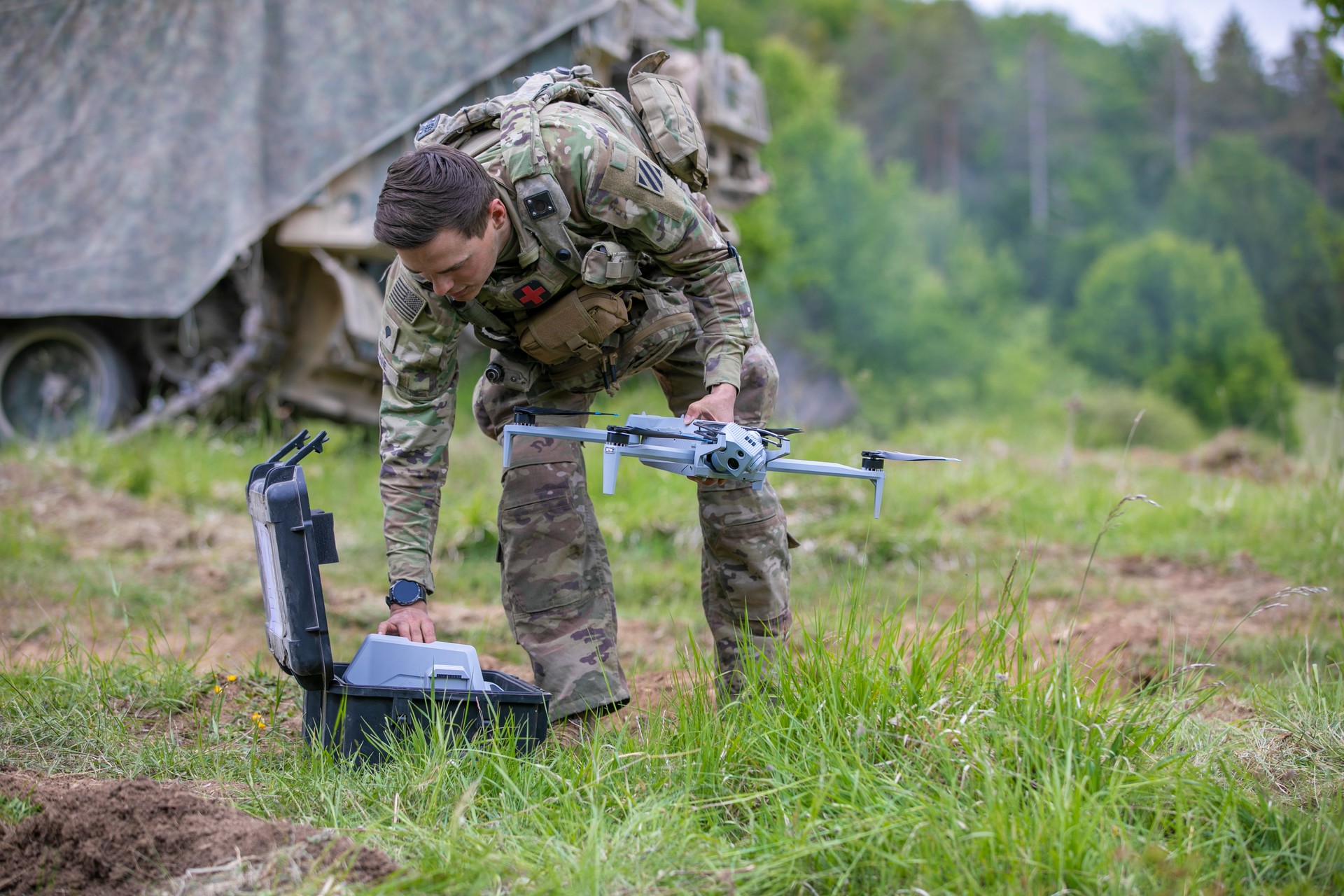
Ukraine changed the visible landscape. Russian and Ukrainian forces employed Group 1 and Group 2 UAS—commercially available quadrotors, fixed-wing reconnaissance platforms, and first-person-view (FPV) kamikaze drones weighing a few hundred grams to under 25 kilograms—at a scale and density that existing SHORAD inventories could not address cost-effectively. Published analysis from the Royal United Services Institute (RUSI) documented formations facing dozens to hundreds of UAS sorties per day in high-tempo phases of the conflict, with engagement costs per interception that were geometrically unfavorable: a $38,000–$100,000 interceptor against a $200–$1,000 threat vehicle. RUSI Special Report: The Return of Industrial Warfare, November 2023.
The DoD's response included the Replicator initiative, accelerated C-UAS testing, and a series of SHORAD program reviews. What those reviews consistently found was not simply a lack of effectors: it was a fragmented kill chain that could not complete the detect-identify-engage sequence reliably against Group 1–3 threats operating in contested, GPS-degraded, and electromagnetically congested environments.
What M-SHORAD Provides—and What It Does Not
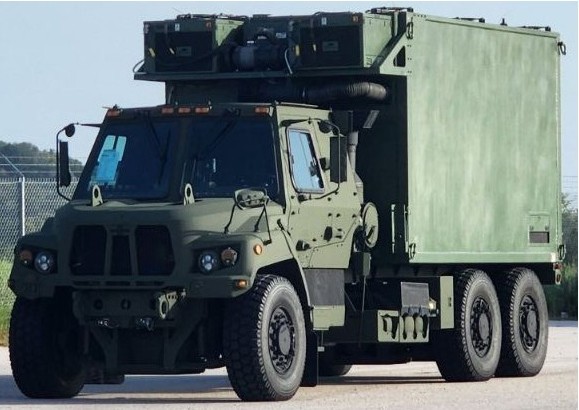
M-SHORAD Increment 1 delivers genuine capability. The Stryker A2-based vehicle integrates Stinger and Hellfire missiles with a 30mm autocannon and the Reconfigurable Charge Assembly System (RCAS), giving an air defense platoon organic fires against helicopters, low-slow fixed-wing aircraft, and some Group 3 UAS. The Army Program Executive Office (PEO) Missiles and Space fielded initial batteries to the 1st Armored Division at Fort Bliss beginning in FY2022. [PEO Missiles and Space M-SHORAD program briefing, AUSA Annual Meeting 2023.]
The system's limitations against the emerging Group 1–2 threat are structural, not developmental. Stinger engagement envelopes require a detectible thermal or radar signature—requirements Group 1 UAS often do not meet. Hellfire costs approximately $100,000 per round. The 30mm cannon can engage at closer ranges but requires accurate track data and a favorable engagement geometry. Against a saturating swarm of FPV drones operating at low altitude in cluttered terrain, none of these options scales to the tactical problem.
Increment 2 addresses part of this gap by integrating a directed energy weapon—the Army's 50kW-class high energy laser (HEL)—into the M-SHORAD platform. Directed energy changes the cost-exchange equation: the marginal cost per engagement is measured in dollars of electricity rather than tens of thousands of dollars per interceptor. But as of mid-2026, Increment 2 had not yet fielded to operational units, and directed energy introduces its own operational constraints: atmospheric degradation in high-humidity and dusty conditions reduces effective range, the system requires generator power that may not be available in all maneuver contexts, and simultaneous multi-target engagements remain limited by beam dwell time requirements.
The directed energy question for acquisition programs is not whether the technology works in a lab—Army test data has demonstrated lethality against Group 1–3 UAS in controlled conditions. The question is whether the integrated system—sensor-to-effector, including the detection and identification chain—works reliably in the environments formations actually operate in.
The Kill Chain Integration Problem
The core gap in formation-level C-UAS is not the effector; it is the integrated kill chain that feeds the effector. The counter-UAS engagement sequence has five steps, and each one presents distinct technical challenges against small UAS:
1. Detect. The Army's primary ground-based air defense radar—the AN/MPQ-64 Sentinel—was optimized for larger threat signatures: rotary-wing aircraft, cruise missiles, and fixed-wing UAS. Group 1 UAS present small radar cross-sections, fly at low altitudes that complicate radar horizon geometry, and may operate in environments where radar clutter from terrain and vegetation degrades detection. RF direction-finding receivers can cue on commercial control links, but adversaries have adopted encrypted, frequency-hopping, and autonomous guidance modes that reduce RF signature. No single sensor type reliably detects the full threat range; detection requires sensor fusion across radar, RF, electro-optical/infrared, and acoustic modalities.
2. Track. A detected contact must be sustained through a track file to enable engagement. Against maneuvering Group 1 UAS at low altitude in complex terrain, maintaining a continuous track across sensor handoffs is not a solved problem. The FAAD C2 (Forward Area Air Defense Command and Control) system manages the air picture for ground-based ADA, but its integration with organic formation sensors—including those not originally designed for ADA use—requires configuration and interoperability work that varies by formation and theater.
3. Identify. Friend-or-foe identification against small commercial UAS in a combined arms operating environment is the most technically consequential problem in this kill chain. Military IFF (Identification Friend or Foe) transponders are not installed on allied rotary-wing aircraft operating below radar coverage, on friendly UAS that lack transponders, or on civilian aircraft that may be present. Engagement of a misidentified friendly platform or civilian aircraft has operational and legal consequences that impose real caution on trigger authorities. The Army's Drone Detection Sensor (DDS) and the broader CUAS Sense-and-Warn ecosystem address portions of this problem, but the identification confidence required before engagement—particularly for lethal effects—remains higher than current automated systems can consistently provide.
4. Engage. Effector selection depends on threat type, engagement geometry, range, and rules of engagement. In a formation operating with both organic ADA assets and electronic warfare systems, de-confliction between kinetic and non-kinetic engagements—jamming a drone's control link versus shooting it—requires coordination that manual processes cannot sustain at Group 1 UAS tempo.
5. Assess. Post-engagement battle damage assessment against small UAS—confirming defeat or requiring re-engagement—is complicated by the small debris signature of these platforms and the speed at which follow-on threats may arrive.
The implication for acquisition: a system that addresses only one or two of these steps adds partial capability that may not translate into operational effectiveness. Programs that have integrated all five steps for the relevant threat categories and environmental conditions are genuinely scarce.
What Evidence Actually Changes the Decision
For a program manager or requirements officer evaluating a C-UAS solution, the following questions separate integration depth from point capability:
- Threat coverage: Which UAS groups does this system address, and under what atmospheric, electromagnetic, and terrain conditions was that performance demonstrated?
- Sensor fusion architecture: How does this system combine inputs from multiple sensor types, and how does it maintain tracks through sensor handoffs and contested conditions?
- Identification confidence: What is the false-positive and false-negative rate for friendly/civilian identification at the relevant threat speeds and altitudes? Under what conditions has this been tested?
- FAAD C2 / IBCS integration: Does this system interface with the formation's existing air picture, or does it require a parallel operator workflow?
- GPS-degraded performance: What is detection and track performance in environments where GPS-dependent positioning is unavailable or spoofed?
- Operator workload: What training pipeline is required, and how many operators does the system require at engagement tempo?
The Army's Counter-UAS Strategy, published in 2021 and updated in subsequent program reviews, explicitly frames layered defense as the doctrinal answer—multiple effector types at multiple ranges, integrated through a common C2 architecture. [Department of the Army, Army Counter-Unmanned Aircraft Systems Strategy, 2021.] The operational challenge is that the common C2 architecture is still maturing, and formations acquiring individual C-UAS point solutions may be building layers that do not communicate.
The AI Integration Point and Its Limits
Artificial intelligence is being applied to several nodes in the C-UAS kill chain, most productively in sensor fusion and threat classification. Machine learning models can correlate tracks across radar, RF, and EO/IR sensors faster than human operators and can classify UAS by flight pattern, acoustic signature, and RF emission profile. The Army's CUAS Sense-and-Warn system and its successors incorporate AI-enabled detection for this reason.
Two constraints define what AI can and cannot contribute in this context. First, model performance degrades against novel threat configurations—adversaries who modify commercial UAS flight profiles, change control frequencies, or add electronic deception measures can defeat classifiers trained on historical data. Continuous model updates require operational data collection pipelines that most acquisition programs have not yet built into their sustainment frameworks.
Second, DoD Directive 3000.09, updated in January 2023, requires that lethal autonomous weapon systems operate with appropriate levels of human judgment over the use of force. [DoD Directive 3000.09, January 2023.] AI-enabled identification can reduce operator cognitive burden and decision time, but the engagement authority chain—who approves a kinetic engagement, under what rules, against what threat category—must remain specified in the system's design. Programs that present AI identification as a substitute for that authority chain rather than a support to it will face authorization and legal review challenges during fielding.
The Credible Alternative: EW-Centric C-UAS
Electronic warfare-based C-UAS—jamming drone control links, GPS spoofing to redirect threats, and signal-denial to ground stations—offers a different cost-exchange profile and does not require kinetic engagement authority. The L-MADIS (Light Marine Air Defense Integrated System), employed in the Middle East theater since 2019, uses a combination of radar, EO/IR, and EW to detect, track, and defeat Group 1–3 UAS primarily through non-kinetic means. [DoD news: L-MADIS fielded to U.S. Marine Corps units in Middle East AOR, 2019.]
EW-centric approaches have their own limitations: they are ineffective against UAS operating on autonomous guidance that does not depend on a control link (inertial navigation, computer vision guidance), and they can create electromagnetic fratricide risks in congested spectrum environments. Formations that rely primarily on EW C-UAS against a capable adversary that anticipates this approach will encounter adapted threats. The practical answer is layered: EW as the primary non-kinetic tool against the bulk of the threat, with directed energy and kinetic interceptors for threats that defeat EW.
What Buyers Should Demand
A C-UAS acquisition decision that is not layered in architecture is not ready for the threat environment the Army will operate in. The specific evaluation steps:
- Require live-fire or operationally representative testing results against Group 1–2 threats, not just Group 3+.
- Require FAAD C2 or IBCS integration demonstration, not just a vendor interoperability claim.
- Specify GPS-degraded and high-EMI performance requirements as threshold criteria.
- Require an identification confidence specification tied to rules of engagement requirements.
- Request sustainment architecture for AI model updates, including the data pipeline and update cadence.
- Evaluate the directed energy maturity timeline against the formation's fielding schedule—a capability five years away is not a capability for the current program increment.
The formation that wins the C-UAS fight will not be the one with the largest interceptor magazine. It will be the one that completes the detect-identify-engage chain faster, more reliably, and at lower cost per engagement than its adversary can saturate.
Spartan X's work at the intersection of AI verification and tactical edge integration—testing whether AI classification systems perform as specified under operationally representative conditions and failure modes—directly addresses the assurance gap that C-UAS programs face at the identification node. A C-UAS system that carries an untested AI classifier into the engagement authorization chain is a liability, not a capability. Verification of that classifier against adversarial UAS configurations, degraded sensor inputs, and novel threat signatures is the acquisition step that most programs are deferring.
Sources and further reading
- RUSI Special Report: The Return of Industrial Warfare (November 2023) — rusi.org
- PEO Missiles and Space, M-SHORAD Program Overview, AUSA Annual Meeting 2023
- Department of the Army, Army Counter-Unmanned Aircraft Systems Strategy (2021)
- DoD Directive 3000.09, Autonomy in Weapon Systems (updated January 2023) — defense.gov
- CSIS: Counter-UAS Technology and Policy (2024) — csis.org
- DoD news: L-MADIS forward deployment, U.S. Marine Corps, 2019