What the Army actually documented
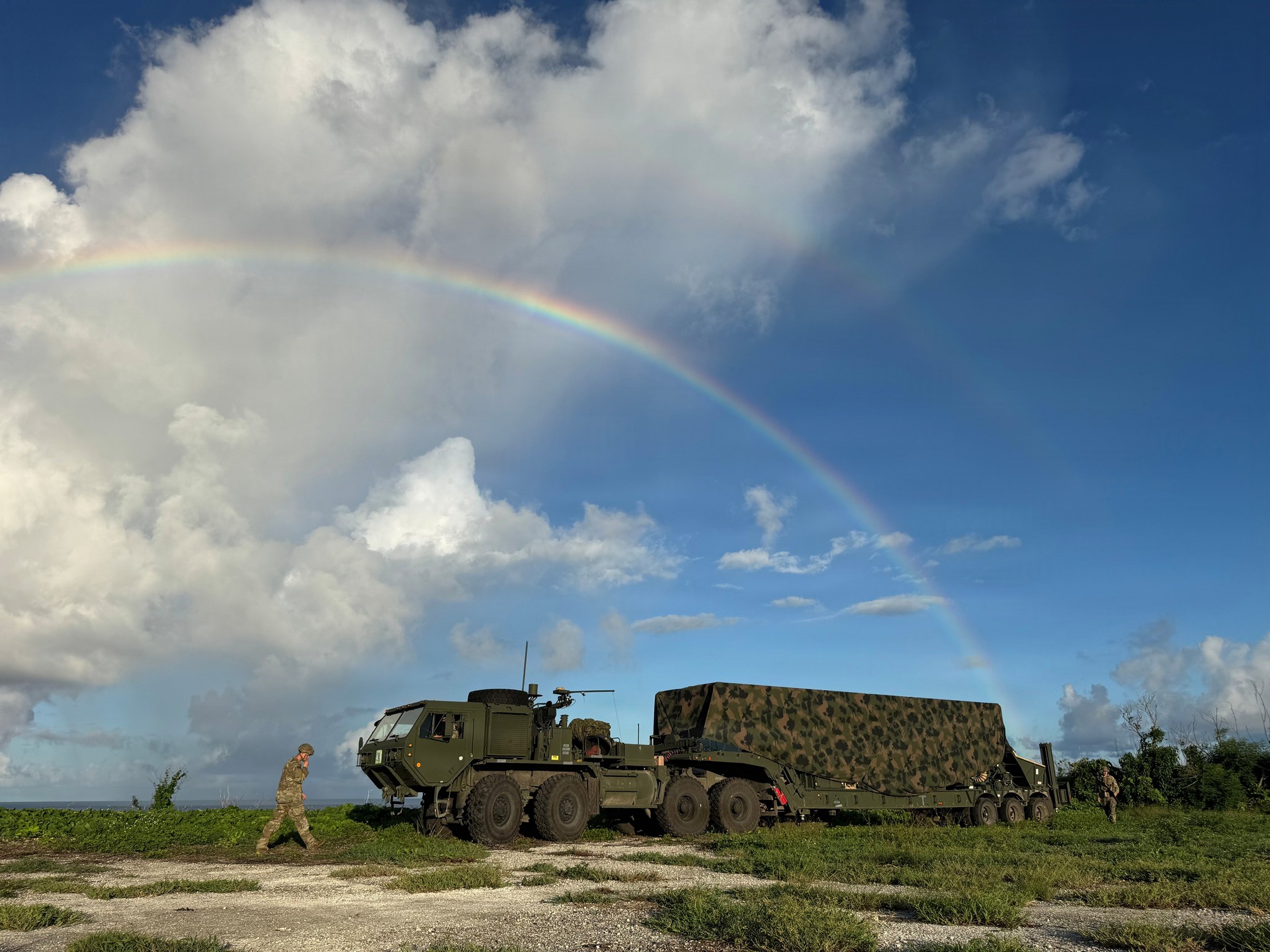
The Army's July 20 photo story identifies Dark Eagle equipment and soldiers assigned to the 7th Infantry Division's Multi-Domain Command-Pacific during June training. It shows Paparo observing the activity and describes the exercise's purpose as integrating joint and allied forces. Those are meaningful indicators of command attention and practical integration work. Army: Dark Eagle at Valiant Shield 26
The account does not establish that live missiles were present, that a weapon was fired, or that the system remained in theater afterward. It also does not support detailed claims about which mainland targets could be reached from an assumed location. Assessing readiness from photographs requires restraint: equipment presence, trained crews, accepted munitions, operational certification, and sustained availability are separate facts.
Dark Eagle is the Army's Long-Range Hypersonic Weapon, or LRHW. It shares important development elements with the Navy's Conventional Prompt Strike program. That common effort makes its progress relevant to both land and maritime acquisition, while each service still has its own integration and support requirements. GAO's Army-Navy hypersonic assessment
The earlier Australia deployment provides useful context
The Army's account of Talisman Sabre 25 identifies B Battery, 5th Battalion, 3d Field Artillery Regiment, presenting the system in Australia's Northern Territory on July 9, 2025. The Army characterized the event as the system's first operational employment outside the continental United States. That wording describes the reported exercise milestone; it should not be treated as proof of a live-fire event or completion of every fielding requirement. Army Talisman Sabre account
Taken together, the Australia and Valiant Shield records show why exercises matter during the introduction of a complex capability. They create opportunities to work through transport, personnel, communications, support, and organizational coordination in settings beyond the development facility. Public reporting does not disclose every result, so the value of the exercise should be assessed through what was demonstrated and what remains to be established.
A new system's transition into the force is rarely one clean moment. The equipment, people, approved procedures, test evidence, and sustainment arrangements can mature on different schedules. Leaders need a common view of those schedules to understand what the force can actually rely on.
Deterrence depends on credible availability
Ground-based long-range capabilities can add another element to the joint force's portfolio. Their strategic contribution depends on more than a published range or a launcher appearing in a photograph. Availability, survivability, support, command arrangements, and political agreements all affect whether a capability can be used as intended.
Ground equipment also remains subject to maintenance, movement, personnel demands, and operational wear. It should not be described as immune to the effects of operating tempo or as permanently present simply because it does not generate aircraft sorties. Every basing and deployment model has support requirements and limitations.
The broader policy context includes the United States' August 2, 2019 withdrawal from the Intermediate-Range Nuclear Forces Treaty. The Defense Department attributed that decision to Russian violations and said it would pursue ground-launched conventional missile development. This explains part of the changed policy environment; it does not establish the reach or readiness of a particular 2026 deployment. Defense Department INF statement
For a public assessment of deterrence, the strongest claim is therefore about the direction of capability development and integration. The degree of operational effect requires evidence beyond the exercise announcement.
Joint development creates shared obligations
The common Army-Navy effort offers opportunities to share development and test investment. It also makes coordination important when quantities, schedules, or requirements change. A decision that benefits one service's immediate milestone can affect a shared supplier, test plan, or production investment used by the other.
GAO's July 2026 review identifies continuing cost, production, testing, and integration challenges in the hypersonic effort. Successful tests are important evidence of progress, but they do not remove the need to demonstrate reliable production and complete platform integration. GAO-26-107974
This is why acquisition leaders should avoid treating the developmental milestone, production plan, and operational inventory as one number. A round required for testing or training is not automatically available for another purpose. A planned production increase is not an accepted delivery. A shared component does not eliminate service-specific work.
Budget uncertainty belongs in that assessment as a planning risk. The effect of any continuing resolution or appropriation depends on the actual enacted terms, applicable authorities, and program circumstances. Budget planning should distinguish enacted funding conditions from forecasts of possible restrictions and show how each affects delivery assumptions.
Questions a readiness review should answer
A useful review can remain clear without disclosing sensitive operational details:
- What milestone is being claimed? Distinguish training, developmental testing, delivery, acceptance, and operational designation.
- What evidence supports it? Identify the responsible authority and the scope of the assessment.
- Which dependencies remain? Track platform integration, trained personnel, support equipment, infrastructure, and test requirements.
- How is sustainment resourced? Establish the accountable organizations and the costs of maintaining the capability over time.
- How are shared investments coordinated? Reconcile Army and Navy assumptions about production, testing, and supplier capacity.
- What changes the forecast? Show how funding, test outcomes, and delivery performance affect the schedule and available capability.
These questions connect the strategic promise to the less visible work that makes it dependable. Valiant Shield is significant because integration with the joint force is part of fielding a useful capability. The enduring test is whether that integration can be supported, repeated, and sustained.
Sources
- Army: Dark Eagle at Valiant Shield 26
- Army: Talisman Sabre 25 deployment account
- GAO: hypersonic development and production assessment
- Defense Department: August 2, 2019 INF statement
Spartan X's engineering, logistics, and program execution experience addresses the connection between a technical milestone and a supportable capability: aligned schedules, visible dependencies, and readiness claims backed by evidence.