What Changed on November 13—and What Didn't
The changes are precise. The CDAO's official designation is now the DoW Super Intelligence Office. The organization launched a new logo, a new primary domain at si.mil, and new social channels at DoW SIO on LinkedIn and @SIODoW on X. All public-facing acquisition resources and partnership portals moved to si.mil as of the announcement.
What did not change: active contracts, open solicitations, ongoing industry engagements, and the programs the office manages. According to the Department's announcement, existing operational programs, industry solicitations, and defense partnerships will continue uninterrupted under the new banner. The organizational updates to digital systems, enterprise applications, and component headquarters are rolling out over the coming weeks.
The rebrand came with one significant personnel note. Cameron Stanley, who took the CDAO role in January 2026 after Douglas Matty left to focus on the Golden Dome missile defense program, now carries the title of Chief Super Intelligence Officer. Stanley previously served as national security transformation lead at Amazon Web Services and led the Algorithmic Warfare Cross-Functional Team—the program known as Project Maven. His statement on the redesignation: "We have moved beyond experimental prototypes. As the Super Intelligence Office, our mission is to harness the full power of sovereign Super Intelligence to ensure decisive military superiority across every domain."
The office reports to Under Secretary of War for Research and Engineering Emil Michael, who was sworn in to that role on May 20, 2025.
The Architecture Underneath the New Name
Understanding what the SIO actually manages matters more than the name. The two anchor programs are Maven Smart System and the War Data Platform.
Maven Smart System is the department's AI-enabled intelligence and operations platform. What started in 2017 as Project Maven—a computer-vision program for analyzing full-motion video—is now a multimodal capability with agentic functionality. Palantir is the prime contractor under the current Maven follow-on contract, which carries a ceiling of approximately $1.3 billion through 2029 under contract W911QX-24-D-0012—a $480 million award in May 2024, raised to $1.275 billion after a May 2025 modification. A March 2026 Deputy Secretary of Defense memo moved full Maven oversight to the CDAO. The same month, Palantir published details on MSS's ability to ingest external AI-generated detections and make them available to AI agents for natural-language querying—a signal that Maven is operating as an integration layer, not a standalone tool.
War Data Platform provides the data integration layer that connects Maven and other agentic applications to enterprise data across the department. In July 2026, Accenture Federal Services received an $821 million task order for core integration work on the platform, covering data operations, tool integration, cybersecurity, and service desk support. That award was processed through the GSA ALLIANT 2 vehicle.
Two additional programs sit under the SIO's "Pace-Setting Projects" framework:
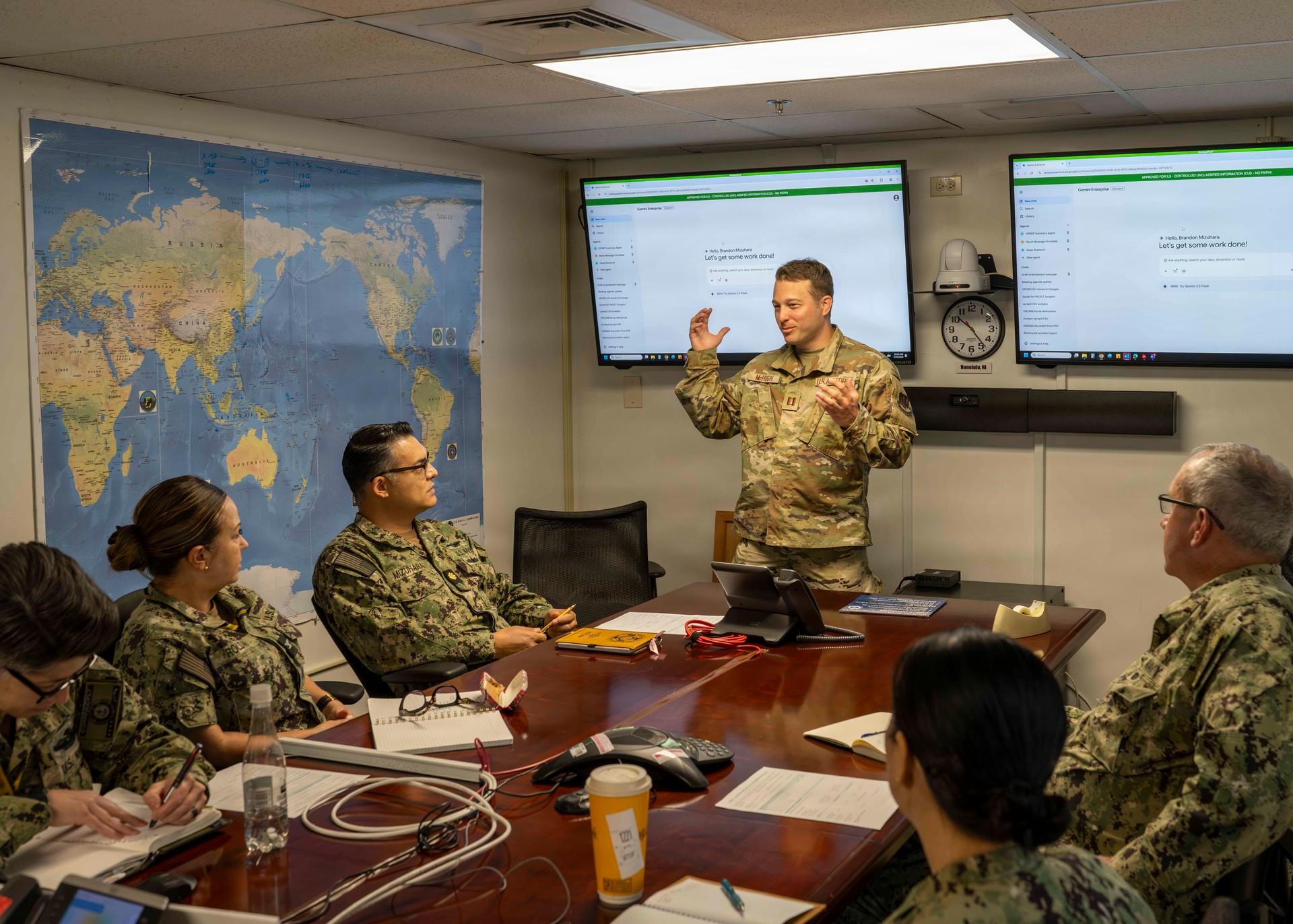
GenAI.mil provides department-wide access to frontier generative AI models—currently Google Gemini and xAI Grok—for DoW personnel at Impact Level 5 and above. The program has been running integration sprints with component commands, including a September 2026 exercise where CDAO GenAI Task Force personnel embedded with the 3rd Mobile Brigade Combat Team, 101st Airborne Division, to integrate Maven and GenAI.mil into the military decision-making process during a command post exercise at Fort Campbell.
Enterprise Agents is building the playbook for agentic AI development and deployment across enterprise workflows. The department awarded an $800 million joint contract in late 2025 to xAI, OpenAI, Google, and Anthropic specifically structured around agentic capabilities and frontier-model access—the first federal contract of that structure.
Scale AI holds a $249 million Thunderforge contract with the former CDAO for data labeling and model evaluation, the largest dedicated AI data-services contract in the defense sector.
What the "Super Intelligence" Framing Actually Signals
The terminology shift is not just political compliance with a presidential directive. It reflects a strategic position the department has been moving toward since the 2026 AI Acceleration Strategy established the Pace-Setting Projects framework with "single accountable leaders, aggressive timelines, measurable outcomes, and rapid iteration where failure accelerates learning and improvement."
"Super intelligence" in this context carries a specific departmental meaning: SI as a warfighting instrument that generates decision advantage across all domains, not AI as an enabling service sitting behind human workflows. The SIO's stated mission—enabling an "SI-First" military—is a posture claim. It says that SI is not one input among many but the organizing principle for how the department wants to structure sensing, analysis, and action.
The parallel organizational move matters here. President Trump also established a "Super Intelligence Force" coordinating federal SI efforts government-wide, led by Director of National Intelligence Jay Clayton. Emil Michael—the CDAO's immediate superior—sits on that task force alongside FTC Chairman Andrew Ferguson and OPM Director Scott Kupor. That structure suggests the SI rebranding is not purely DoW-internal; it reflects an intent to coordinate SI investment and governance across the intelligence community and civil executive branch simultaneously.
Acquisition Implications for Contractors and Program Managers
Tradewinds rebranding. Tradewinds is the CDAO's AI and data solutions marketplace, designed to accelerate DoW access to AI, ML, and data analytics technologies through streamlined "Awardable" designations. The marketplace itself has not been officially rebranded as of the November 13 announcement, but all associated materials are transitioning to si.mil over the coming weeks. Contractors holding Tradewinds Awardable designations should expect updated documentation requirements. Organizations currently in the Tradewinds pipeline should verify that their points of contact have updated domain routing.
Solicitation and contract language. The department acknowledged that the name change will be "reflected in the office's digital systems, enterprise applications and component headquarters over the coming weeks." Active solicitations issued under CDAO identifiers are unaffected—the transition clause in the announcement covers that. But new solicitations issued after the transition period will carry SIO identifiers. Program managers tracking procurement against CDAO-branded vehicles should confirm with their contracting officers which identifier governs amendment issuance.
Component CDAO offices. The service branches maintain their own chief data and AI officer positions. The Army's deputy CIO and chief data officer, Air Force data offices, and similar component positions operate under separate organizational structures. The DoW-level SIO redesignation does not automatically rebrand those offices, though the Army's own CDAO structure has been adapting to the 2026 AI Acceleration Strategy's framework independently.
The sovereign SI requirement. Stanley's statement emphasized "sovereign" Super Intelligence—a distinction the department has signaled through its model-access strategy. GenAI.mil's current offerings (Gemini, Grok) represent frontier capability from U.S.-based companies accessible at IL-5. The department's concern about supply-chain sovereignty in AI models—ensuring that the models underlying military workflows are not dependent on foreign foundation-model providers—is a persistent consideration that contractors integrating AI into defense systems will increasingly need to address in technical proposals.
What Would Change a Decision Here
The rebrand is a declaration, not a capability delivery. The question program managers should ask is whether the execution infrastructure has actually caught up to the "beyond experimental prototypes" claim.
The evidence is mixed. Maven is a genuinely operational platform with large-scale prime contractor support. The War Data Platform core integration contract is newly awarded and covering foundational work. GenAI.mil has access to frontier models at scale. But the Pace-Setting Projects framework is less than a year old, the 101st Airborne CPX exercise in September was the kind of field integration event that proves the concept, not the deployment. If the SIO's execution cadence over the next two quarters matches the ambition of the rebrand, the "SI-First" posture will carry weight in RFP language and evaluation criteria. If the PSP timelines slip, the name change will look like what critics already called it: a rebranding exercise ahead of substance.
A contractor making a build-or-partner decision on defense AI should watch two indicators: how quickly Tradewinds Awardable designations start drawing direct task orders under the new branding, and whether the Enterprise Agents program issues a contract vehicle broad enough to serve as the SIO's answer to what CDAO's $800M agentic AI contract started.
Next Decision for Program Managers
If you are a program manager with CDAO-originated contracts or access agreements:
- Verify your contracting officer's awareness of the SIO transition timeline and confirm whether your program's contracting vehicle requires a modification for identity changes.
- Update your internal program documentation to reflect si.mil as the authoritative reference for SIO policy and acquisition guidance.
- If you are a subcontractor to a Tradewinds Awardable prime, confirm that your prime has updated their vendor documentation under the new identifier structure.
If you are a defense AI contractor evaluating whether to pursue new SIO vehicles:
- Watch the Tradewinds marketplace at si.mil for how quickly new Awardable designations are issued under the SIO banner—that cadence signals how aggressively the office is expanding its accessible contractor pool.
- Review the GenAI.mil and Enterprise Agents solicitation structures when they issue; both programs are acquiring capability at a scale that creates meaningful subcontracting and integration opportunities.
Spartan X has worked across AI strategy, platform integration, and AI assurance requirements in both enterprise and tactical contexts. That operational experience with how AI tools interact with existing command and data infrastructure—where integration friction concentrates, and what it takes to verify that a capability works as specified under field conditions—is directly relevant to the challenges the SIO's Pace-Setting Projects are driving toward.
Sources and further reading
- Department of War: Redesignates CDAO as Super Intelligence Office (Nov. 13, 2026)
- Super Intelligence Office official website
- Inside Defense: Pentagon rebrands CDAO as Super Intelligence Office (Nov. 13, 2026)
- CSIS: What Is Maven Smart System, and What Does It Do? (June 2, 2026)
- Executive Gov: DOW CDAO Rebrands as Super Intelligence Office
- Presenc AI: Defense AI Contract Map 2026