Why Glide Phase Is the Interceptor Gap
Ballistic missiles follow predictable arcs through the upper atmosphere. The Ground-Based Midcourse Defense system and SM-3 Block IIA are designed for exoatmospheric intercept — outside the atmosphere, in midcourse flight. The SM-6 in the Sea Based Terminal Increment 3 configuration engages threats in the terminal phase as they reenter the atmosphere.
Hypersonic glide vehicles occupy the space between. After release from a booster, they skim the upper atmosphere at hypersonic speeds while maneuvering — making trajectory prediction unreliable and collapsing engagement timelines. They fly too high for the SM-6's practical terminal coverage and too low for the SM-3's exoatmospheric engagement envelope. That gap is structural, not a failure of existing interceptors.
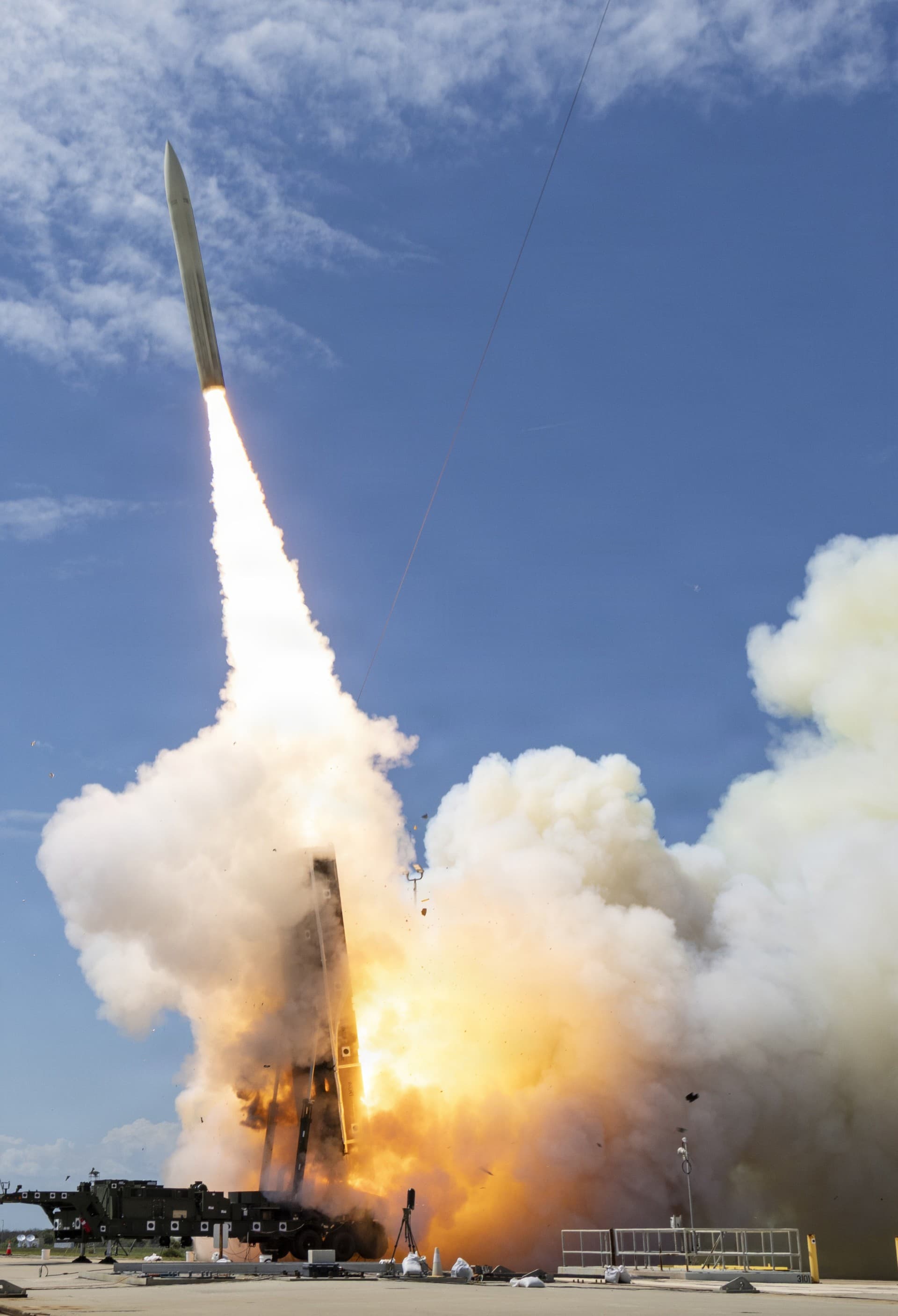
GPI is designed to fill it with a hit-to-kill interceptor capable of sustained maneuvering at hypersonic altitudes. The guidance and propulsion requirements are substantially harder than for a midcourse interceptor operating on a predictable threat track. Competitive designs did not emerge until 2022; the program down-selected to a single prime contractor in September 2024.
Acquisition Status: Single Prime, Accelerating Timeline
The down-select of Northrop Grumman as the sole prime for GPI engineering and manufacturing development was completed in September 2024, with Raytheon eliminated from the competition at that stage. Lockheed Martin had been eliminated from the program in June 2022.
The April 3, 2026 contract modification increased the total contract value from $832.8 million to approximately $1.31 billion (as of that modification), adding flight tests to reduce technical risk, expanded multi-mission capability development, and exploration of additional launch strategies. Work under the modification runs through June 2028. The modification is consistent with the MDA FY2026 budget justification, which describes the FY2026 Hypersonic Defense request of $447.6 million — $200.6 million in discretionary RDT&E and $247 million in mandatory reconciliation — as accelerating GPI capability delivery from the mid-2030s to 2032. In April 2026 HASC testimony, MDA Director Lt. Gen. Heath Collins indicated that reconciliation funding put GPI back on track to deliver in 2031 — a further pull-forward from the 2032 figure in the budget justification.
The current engineering work includes simulations of extreme temperature conditions, trials of interstage separation systems, and fire control model integration with the Aegis Weapon System. These are the technical elements that must stabilize before the PDR can be considered successful.
The Japan Partnership: What 50-50 Workshare Actually Means
The cooperative development structure is bilateral in both ownership and risk. The U.S.-Japan cooperative development agreement was signed May 15, 2024, under the existing U.S.-Japan MOU for Research, Development, Test and Evaluation projects. Under the arrangement, MDA leads system development and program management; Japan leads design and manufacture of the rocket motors and propulsion components to be integrated into the GPI All-Up-Round.
In November 2024, Japan's Ministry of Defense awarded Mitsubishi Heavy Industries a contract worth approximately ¥56 billion (~$350 million) for the propulsion components, with delivery scheduled for March 2029. Northrop Grumman publicly described the resulting workshare as approximately 50-50 in April 2026, which Naval News characterized as a high degree of technical integration.
The deployment footprint reflects both sides. GPI is sized for the Mk 41 Vertical Launching System, enabling deployment on U.S. Navy DDG-51 Aegis destroyers and on Aegis Ashore batteries in Poland. Japan Maritime Self-Defense Force Aegis destroyers are planned for subsequent integration. Japan is also developing its own Aegis System Equipped Vessel (ASEV) program to replace Aegis Ashore, with the first ASEV planned for March 2028 and a second for March 2029 — the same month as the scheduled MHI propulsion delivery.
That convergence is the central schedule risk. The March 2029 MHI delivery is the earliest practical date at which integrated all-up-round testing could begin. A slip in MHI's propulsion development, or a delay in Japanese government acceptance, would push all subsequent integration testing to the right — and with the 2031 delivery target, the program has limited cushion to absorb a delay of any length.
Aegis Integration: The Configuration Management Problem
GPI does not work without Aegis. The interceptor is designed to integrate with the modified Baseline 9 Aegis Weapon System, which carries the Sea Based Terminal Increment 3 fire control capability. The MDA and Navy successfully exercised the SBT Increment 3 capability in the latest Aegis software baseline on March 24, 2025, in Flight Test Other-40 (FTX-40, "Stellar Banshee"): USS Pinckney (DDG 91) detected, tracked, and performed a simulated SM-6 engagement of an advanced maneuvering hypersonic target vehicle launched from a C-17 aircraft off the Pacific Missile Range Facility, Kauai. The test was a tracking and fire control chain verification, not a live intercept.
The follow-on test, Flight Test Aegis Weapon System-43 (FTM-43), is planned as a live intercept of an HTV-1 target using the upgraded SM-6. FTM-43 would validate that the fire control baseline can close a real engagement — a significant risk-reduction step for GPI integration.
The engineering model connecting GPI to the modified Baseline 9 Aegis software is part of the ongoing program work. A fire control model is not a deployed fire control system. The path from a validated engineering model to a ship-qualified software release runs through hardware-in-the-loop testing, at-sea verification, and regression testing against all existing Aegis capabilities. Defects that require a software baseline reversion at that stage can restart the certification sequence.
DDG-51 hulls scheduled for the Baseline 9 upgrade need to be available for GPI integration testing after completing their Aegis modernization. Program offices tracking which hulls are in the upgrade queue, and when they return to operational availability, are the ones who will see a GPI integration schedule slip before it affects the milestone documents.
The C2 Dependency That Is Often Understated
GPI fires from a ship; the targeting chain does not begin there. The interceptor depends on an upstream sensor-to-fire-control data path that runs from space-based tracking assets through the Command and Control, Battle Management, and Communications (C2BMC) system to the Aegis ship's fire control. The MDA's FY2026 budget explicitly identifies "developing and demonstrating a C2 data mesh supporting critical early delivery for Golden Dome for America" as a program highlight alongside the GPI acceleration.
Golden Dome for America is the administration's integrated missile defense architecture, within which GPI is a glide-phase layer. The C2 data mesh that connects that layer to the others — including the Space-Based Interceptor constellation that the Space Force's Space Combat Power PEO is developing under up to $3.2 billion in Other Transaction Authority agreements, awarded across 20 OTAs to 12 companies in late 2025 and early 2026 — is itself in development. The MDA's budget describes it as a C2 mesh under development; that is not a fielded capability.
A GPI battery with integrated hardware and verified fire control software still cannot execute a layered engagement scenario without a validated connection to the C2BMC mesh and through it to the upstream space tracking layer. For operational planners writing requirements documents for FY2027 and beyond, the operational GPI scenario requires all three elements: the interceptor, the ship's fire control, and the data mesh — and the data mesh has its own schedule that is driven by Golden Dome architecture decisions still in progress.
Practical Decision Set for the 2027 Budget Cycle
Acquisition offices working FY2027 exhibits and program documents should be pressing on the following:
- MHI delivery schedule visibility. What intermediate delivery milestones has the Japan Ministry of Defense established for the Mitsubishi Heavy Industries propulsion contract, and what is MDA's current assessment of schedule risk against the March 2029 delivery? If the March 2029 delivery slips, all subsequent integration testing shifts right — and with delivery targeted for 2031, the program has limited cushion to absorb the delay.
- Aegis hull availability sequence. Which DDG-51 hulls are programmed for the Baseline 9 upgrade, and when do they exit their depot availability window? A ship that completes the software upgrade too late in 2029 or 2030 cannot complete the at-sea GPI verification sequence before IOC. This hull availability sequence is plannable now from the surface warfare sustainment schedule.
- C2 mesh interface specification. Has the C2BMC program office published an interface control document governing how GPI-equipped ships receive cueing from space-based tracking assets? An interface specification that does not exist before the PDR will generate design changes after it. Northrop targets PDR by 2028; interface ambiguity that survives into PDR often produces cost and schedule growth at CDR.
- Interim capability documentation. The SM-6 in SBT Increment 3 configuration is the fleet's current capability against maneuvering hypersonic threats in the terminal phase. MDA's FY2027 budget also includes Project Maverick, a planned interim counter-hypersonic flight test on the East Coast using engage-on-remote. Program offices should document explicitly which engagement scenarios SM-6 SBT Increment 3 addresses, what Project Maverick is intended to demonstrate if the FY2027 test proceeds as planned, and which scenarios remain uncovered until GPI is fielded — rather than crediting GPI IOC to scenarios it cannot yet execute.
Sources and further reading
- Department of War, Contracts for April 14, 2026 (MDA OTA modification, $475.3M)
- Northrop Grumman, GPI Development Modification Contract announcement, April 15, 2026
- MDA, FY2026 RDT&E Budget Justification, Hypersonic Defense
- Defense News, US and Japan sign GPI cooperative development agreement, May 15, 2024
- Naval News, US-Japan GPI Workshare Revealed: Northrop Details 50-50 Split, April 2026
- The Defense Post, US Awards Northrop $475M for Hypersonic GPI Design, April 15, 2026
- MDA/Navy, FTX-40 Stellar Banshee flight test results, March 25, 2025
- Space Systems Command, Space-Based Interceptor program OTA awards
- DefenseScoop, MDA Project Maverick, Director HASC testimony, May 11, 2026
Software-intensive systems in the engagement chain — where decision logic must behave consistently under sensor uncertainty and constrained authority — create an assurance challenge that adds demands beyond conventional test-and-evaluation. Establishing confidence in AI-assisted decision aids before operational deployment requires independent, evidence-based evaluation of behavioral consistency, drift, and error. That class of problem is what Spartan X is addressing through Arbiter, which is in development as an assurance platform for AI instances in high-stakes applications, with multi-model corroboration as part of the broader Arbiter platform direction.