What the announcement establishes
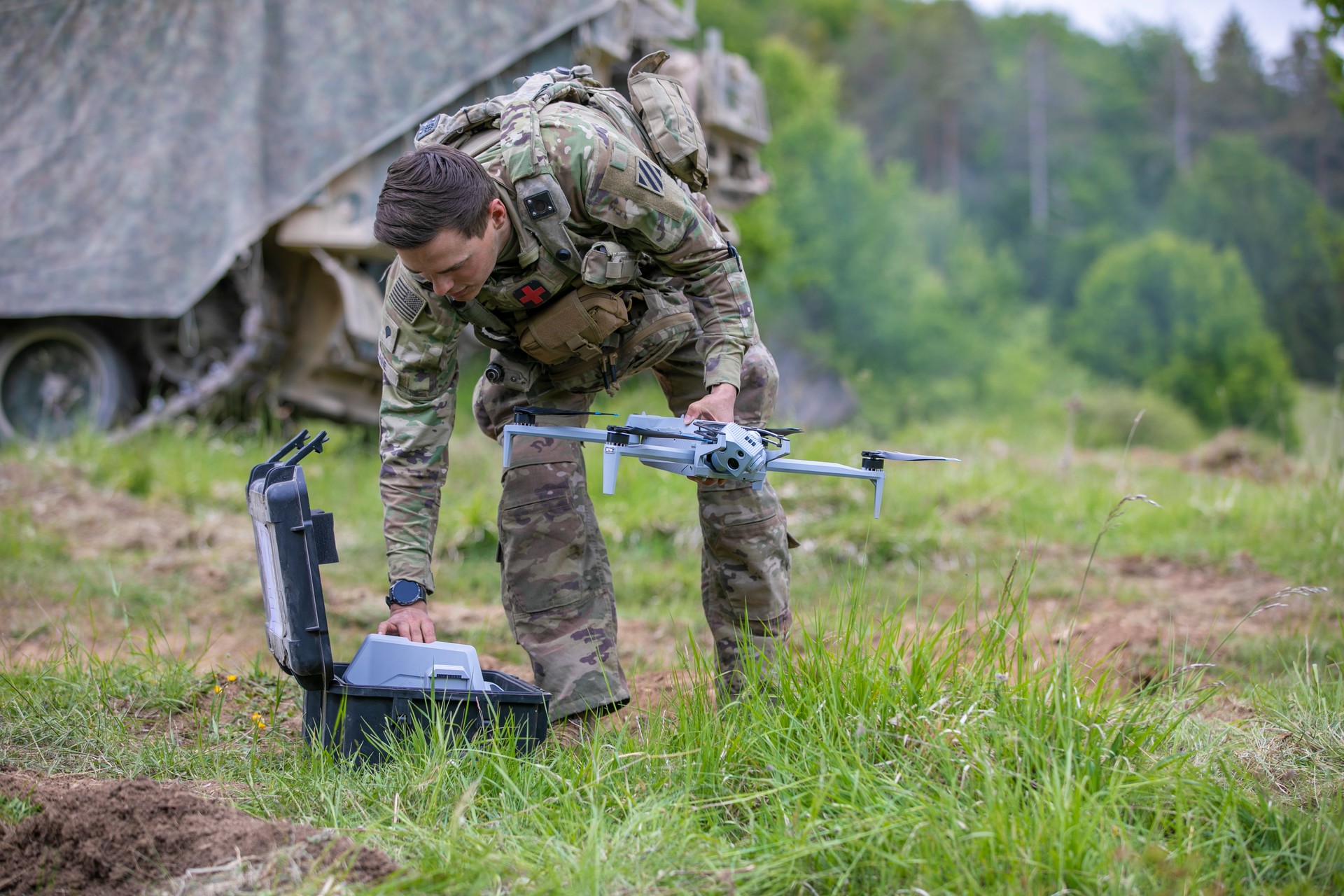
The JIATF 401 announcement republished by Joint Base San Antonio on May 19, 2026 describes a three-year indefinite-delivery, indefinite-quantity contract with a $500 million ceiling awarded to Perennial Autonomy. It covers AI-enabled counter-UAS systems including Merops interceptors, Bumblebee quadcopters and Hornet midrange strike drones. The announcement identifies use by forces in U.S. Central Command's area and emphasizes affordable, attritable capability.
The award is consequential because recurring availability matters in air defense. A system that performs well but cannot be replenished, maintained or integrated at the required rate may leave the customer with a demonstration rather than an enduring capability. Buying for volume brings manufacturing and logistics into the center of the assessment.
It also makes the economics more demanding than a comparison between the sticker prices of two aircraft. A useful cost model includes the supporting equipment, personnel, training, transport, spares, software support and expected consumption. Program teams need enough evidence to compare complete packages serving the same mission.
Why the contract structure matters
FAR 16.504 explains the basic IDIQ mechanism: the government orders individual requirements within stated limits over a fixed period. The contract establishes a minimum and maximum, scope and ordering procedures, including which activities may issue orders.
The $500 million figure is therefore a ceiling. It is distinct from the guaranteed minimum, individual orders, obligations and deliveries. Those distinctions matter to production planning and to public assessments of how much capability the award has actually generated.
An IDIQ can reduce repeated contracting work for requirements within its scope, but it does not automatically give every combatant command unrestricted ordering authority. Nor does the vehicle remove testing, acceptance or applicable approval requirements. Customers and suppliers still need to understand the terms governing a particular order.
For a manufacturer, this creates a practical tension. The contract opens a path to demand, while a ceiling alone cannot justify assuming every available dollar will become an order. Capacity decisions should distinguish firm commitments from forecasts and identify which long-lead investments require stronger customer signals.
Joint coordination still needs accountable execution
The Army's FY2027 budget justification records JIATF 401's establishment in August 2025 to synchronize counter-small-UAS activity. It describes the Secretary of the Army as executive agent with acquisition and procurement oversight and the task force as a Chairman Controlled Activity in the Joint Staff.
That structure supports a joint effort while retaining specific institutional responsibilities. Its practical advantage should be judged through delivery: whether requirements are coordinated, units receive suitable systems, lessons reach the next order and support remains available after fielding.
An integrated program needs an owner for each handoff:
- Demand: who consolidates needs and resolves competing priorities?
- Configuration: who confirms which hardware and software version an order includes?
- Acceptance: who determines that the delivered system meets the agreed requirement?
- Support: who provides training, repairs, updates and replacement inventory?
- Feedback: who turns operational observations into approved changes?
Without those assignments, central purchasing can still produce fragmented sustainment. A common contract is useful only when the organizations using it can manage the resulting capability.
Operational evidence should travel with the system
Experience in conflict can reveal conditions that controlled demonstrations miss. It is valuable evidence, especially about reliability, support burden and adaptation. Its relevance to a new customer depends on the actual configuration, environment, threat and operating procedures involved.
Acquisition teams should ask what was observed, who recorded it and which limitations accompanied the result. A performance claim from one setting should be tested against the intended deployment rather than treated as a universal qualification. Software changes make configuration traceability particularly important: the system ordered today may not be identical to the one associated with an earlier result.
A disciplined evidence package can include:
- The tested configuration and the boundaries of the evaluation.
- Reliability and availability records, including failures and repairs.
- Operator workload, training needs and support requirements.
- Results under relevant communications and environmental constraints.
- The process for reviewing changes before releasing them to operational users.
This keeps rapid procurement connected to learning. It also gives suppliers a way to demonstrate improvements without relying on headline claims that cannot be reproduced or compared.
Mobile defense is a separate delivery problem
A solution supporting an established site may depend on power, communications, transport and personnel that a moving unit cannot provide. Mobile protection deserves its own requirements and evaluation. Size, weight, endurance, setup time and the support burden can change the suitability of the complete package.
That does not establish which vendor or contracting vehicle will address the next requirement. It identifies the questions a customer should resolve before adapting an existing system to a different use. An award to one company also does not automatically create ordering access to another company's product under the same contract.
The broader industrial opportunity remains clear. Counter-drone capability must be affordable enough to sustain and dependable enough to deploy, with manufacturing and logistics aligned to the operational need. The firms that can document all three will give customers a stronger basis for repeat orders than a compelling prototype alone.
Sources and further reading
- JIATF 401: Perennial counter-UAS award announcement, official JBSA republication
- FAR 16.504: indefinite-quantity contracts
- Army FY2027 RDT&E justification, PE 0604531A, project CQ6, acquisition strategy
Spartan X's program execution, logistics and engineering practices bring procurement plans into line with delivery reality: a supportable configuration, credible production assumptions and a replenishment plan the customer can use.