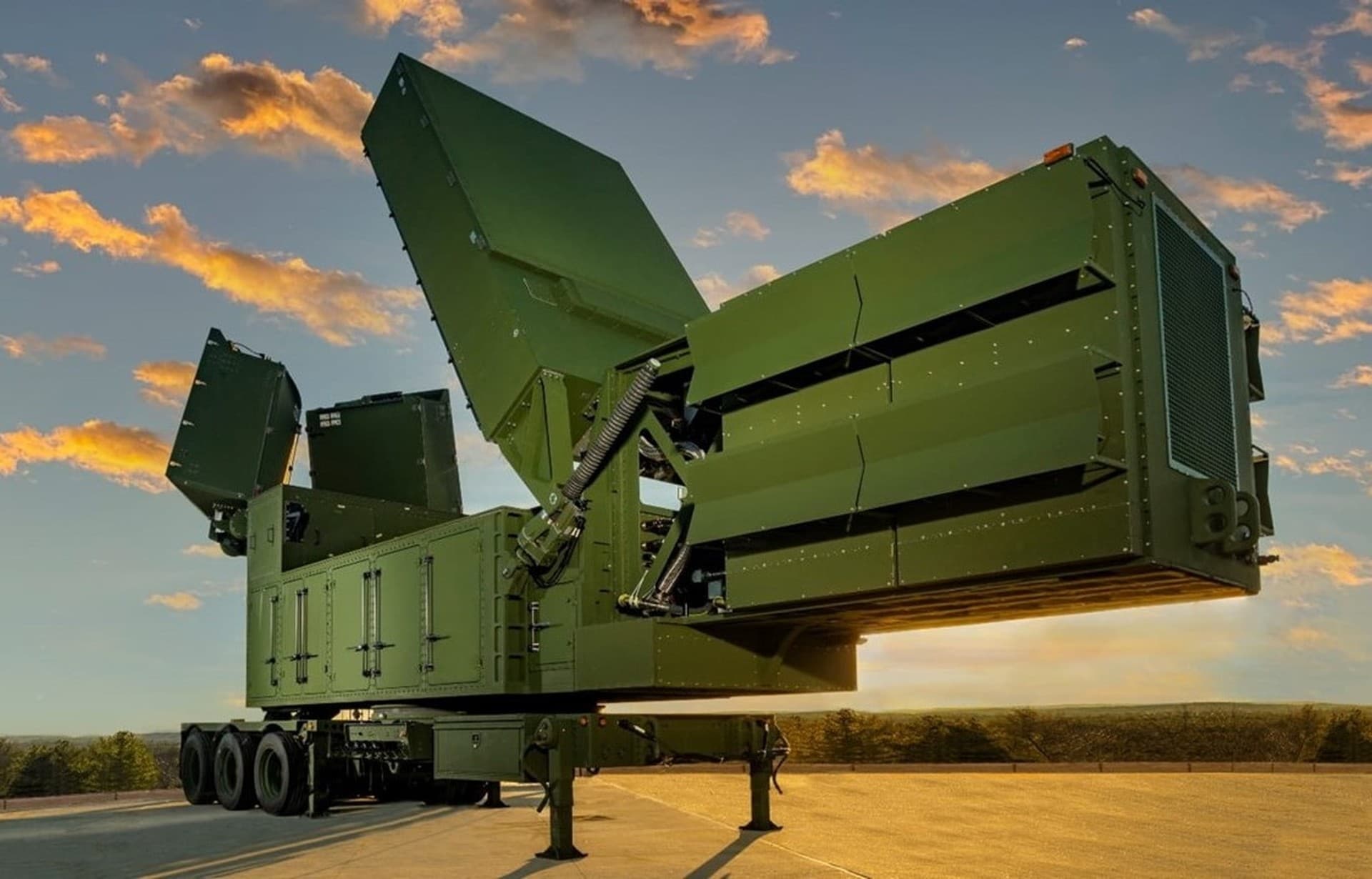
What LTAMDS Changes About Air Defense Sensing
The MPQ-65 Patriot radar, which LTAMDS replaces, is a single-faced system. It provides high-resolution tracking in its forward arc but requires the battery to reorient the entire antenna to track threats from other directions. The hardware dates to a design developed across multiple Patriot configurations through the late 1990s and early 2000s, and while the Army has updated its software repeatedly, the sensor architecture was built around the radar cross-sections and flight profiles common to that era's threat set.
LTAMDS is a C-band, three-faced, fixed active electronically scanned array. Its three panels track simultaneously in all directions without requiring the battery to reorient. The August 14, 2025 demonstration at White Sands—in which LTAMDS successfully detected, tracked and classified an Air Breathing Threat surrogate through its secondary sector array, engaging it through IBCS—shows the 360-degree geometry working in a controlled test. RTX describes the system as providing substantially higher power output than the MPQ-65, supporting engagement of smaller and faster targets, though the DOT&E FY2025 report notes that data against tactical ballistic missiles remain insufficient to assess operational effectiveness against that class of threat.
The second change is architectural. LTAMDS is designed to pass structured data through IBCS's Integrated Fires Network to any compliant effector—PAC-3, PAC-2 GEM-T, and eventually allied systems that implement the IBCS open interface. That shift from sensor-specific integration to an open-architecture data path is the capability the Army needed to make multi-domain layered defense operationally feasible. Poland's WISŁA FOC demonstrates that the IBCS command layer can already accept data from adapted legacy Patriot sensors—a different integration path than LTAMDS, but one that validates the open architecture's interoperability concept.
What 34 Consecutive Successful Flight Tests Actually Establish
The late-April 2026 events at White Sands were two separate demonstrations, not a single combined engagement. In one, IBCS integrated with the Indirect Fire Protection Capability using the Sentinel A4 radar to track and engage a target in the threat regime IFPC is designed for—smaller, slower, low-altitude threats below Patriot's engagement floor. In the other, IBCS used LTAMDS to detect, classify and intercept a distinct target. Both are the 34th consecutive successful flight test under the cumulative count. Neither substitutes for IOT&E.
What 34 consecutive test successes establish is that the IBCS command and sensor integration architecture works repeatedly in controlled range conditions. What they do not establish is consistent reliability at the battery level in the field. The DOT&E FY2025 Annual Report states directly that LTAMDS "is not currently suitable." Operational assessments found low reliability, emplacement and displacement times that exceeded requirements, and failures in some environmental and transportability tests. These are the findings the test program produced; the flight tests and the reliability findings coexist, and program offices should not read the flight test record as overriding the operational assessment data.
The Army's scheduled test event for fiscal year 2026—IFTC 26—is not IOT&E. It supports an urgent materiel release of two non-LRIP-representative LTAMDS prototypes to Guam in the first quarter of fiscal year 2027. DOT&E recommends that formal operational test and evaluation be conducted on LRIP-configured production assets before the full-rate production decision, which is currently projected for the end of the fourth quarter of fiscal year 2028. That timeline means a verified suitability determination is still more than two years away.
There is also a distinction between sensor-and-command integration—what the flight test record covers—and logistics and maintenance integration, which the test program has not exercised at the scale of a deployed brigade. LTAMDS has substantially different maintenance requirements than the MPQ-65. The gallium nitride transmitter assemblies require technicians trained on different electronics and software-defined radar processing than those who maintain the legacy system. The DOT&E reliability data suggest that the maintenance workload at the battery level will be higher than modeled, which makes the training pipeline a critical path item alongside production.
The Industrial Base Arithmetic
The April 2026 contract modification—P00015 to contract W31P4Q-24-C-0024, awarded by Army Contracting Command at Redstone Arsenal—covers five LTAMDS units and six spares, with $725,878,580 in fiscal year 2026 missile procurement funds obligated at award. The work is performed at Raytheon's Andover, Massachusetts facility, with a completion date of August 29, 2031. It is the fourth production lot, following a base award of approximately $2.1 billion in August 2024, a $1.7 billion modification in August 2025 (which included approximately $397 million in foreign military sales funds from Poland), and a $1.02 billion order in February 2026. The cumulative face value of the contract now exceeds $5.35 billion.
The Army's planned buy is 94 total radars, according to Defense News reporting from March 2025. At approximately $125–$130 million per unit for early production lots—the estimate provided by Maj. Gen. Frank Lozano in March 2025, before cost reduction from line maturation—the 94-radar buy represents a capital commitment of roughly $11–12 billion for the sensors alone. Lozano cited an overall program estimate of approximately $13 billion.
For an individual radar, Raytheon's production line currently runs approximately 40 months from award to delivery, with a program objective of 36 months, according to the same reporting. At that rate, the five units from the April 2026 lot will not complete delivery until, by the writer's estimate, late 2029 at the current build time. Each subsequent lot adds roughly three years of delivery lag from its award date. The Army is ramping toward eight radars per year, with a target of twelve—a production ramp that must be sustained through the appropriations uncertainty of the current period.
The continuing resolution (P.L. 119-103) running through December 11, 2026 limits production-rate increases above the rates sustained with fiscal year 2026 funds, and bars new production of items not funded in prior years, per Section 102 of the Act (CRS R49353). The April 2026 lot was funded with fiscal year 2026 missile procurement appropriations, not by the CR. What the CR constrains for fiscal year 2027 is a rate increase: if the Army wants to add a lot that would increase the annual delivery rate above what FY2026 appropriations supported, that increase requires a full-year appropriation. If Congress does not pass a defense appropriations bill before December 11, the Army has the choice of holding at the FY2026 rate or seeking reprogramming authority.
Multiyear procurement authority, if pursued, could reduce unit costs by allowing Raytheon to purchase gallium nitride components and other long-lead materials at volume, and by providing production schedule certainty across years. The Army has not publicly announced a request for multiyear authority for LTAMDS. Its PAC-3 MSE interceptor program received a $4.5 billion multiyear contract for 870 missiles in June 2024 (later definitized at $9.8 billion in September 2025). The different contracting approaches reflect the different maturity stages of each program rather than a settled policy on sensor acquisition.
The Poland Signal: Demand and Priority
Poland's WISŁA system reaching full operational capability on December 18, 2025 is a meaningful milestone for the IBCS program. WISŁA FOC is built on IBCS with adapted legacy Patriot sensors—demonstrating that the IBCS command and integration layer can achieve operational status with sensors other than LTAMDS. It is evidence of IBCS command maturity, not LTAMDS maturity. Poland is an FMS customer for LTAMDS—the August 2025 contract included Polish procurement funds—but no source has confirmed that LTAMDS hardware has been delivered to Polish units.
What the Poland case does establish is that allied demand for IBCS-capable systems is real and precedes U.S. Army completion of its own fielding. RTX has reported that more than a dozen countries have requested LTAMDS pricing and availability data, per a vendor release summarized by iConnect007. Each allied deployment using a different sensor adds an interface validation requirement to the IBCS integration test program—the sensor-to-IBCS data format must be validated for each sensor type. The Army's foreign military sales office and the program executive organization—identified in recent Army communications as Portfolio Acquisition Executive FIRES—should be coordinating those requirements actively rather than after domestic fielding is complete.
The FMS funding dynamic operates in the Army's favor if allied procurement aligns with available production slots. Polish FMS funds pay for Poland's radars; they do not directly subsidize the U.S. Army's procurement. But allied demand can support a larger production run with a more stable production base, which drives unit-cost reduction. Whether that materializes depends on allied budget timelines and FMS case approvals lining up with Raytheon's production schedule.
What Program Managers Should Watch
Four near-term indicators determine whether the LTAMDS production and fielding timeline stays on track.
DOT&E reliability findings. The FY2025 Annual Report's suitability finding—low reliability and unacceptably long emplacement times—is the most consequential open item for the 2027–2028 period. Program offices should monitor the FY2026 test event (IFTC 26), which supports the Guam urgent materiel release of two prototypes in 1QFY27, for any additional reliability data. The formal determination of suitability will come from IOT&E on LRIP-configured assets before the full-rate production decision, projected for end of 4QFY28. Any evidence that emplacement and reliability problems persist in LRIP hardware extends the period before an operationally suitable system is available at scale.
FY2027 appropriations. The continuing resolution that expires December 11 holds production rates at FY2026-sustained levels and bars new production starts. Sustaining the current lot cadence—four lots in approximately 20 months—requires either a full-year appropriation that maintains or increases the missile procurement line for LTAMDS or a CR extension that explicitly covers it at FY2026 rates. The lame-duck session is the window for program offices to communicate production schedule sensitivity to congressional staff and the Pentagon comptroller.
Supply chain for gallium nitride components. LTAMDS uses GaN transmitter modules across its three panel faces. Raytheon's agreement with TTM Technologies, announced January 30, 2026, covers radio frequency assemblies, electronic hardware and printed circuit boards for the sensor, worth up to $200 million over three years. Supply chain disruptions for GaN or transmitter panel assemblies are a realistic source of production schedule slips independent of funding. Program offices should request supply chain risk assessments from the prime contractor with each lot delivery, covering lead times for GaN components specifically.
Maintenance training pipeline. The Army needs trained LTAMDS crews at the unit level before fielded systems can be operated effectively. The DOT&E reliability findings make this a higher-priority planning item than a standard sensor upgrade, because a system with documented reliability shortfalls requires well-trained maintainers who can identify and respond to field failures rapidly. If the training pipeline at the Air Defense Artillery School cannot expand throughput in parallel with deliveries, systems will accumulate in unit inventory ahead of qualified crews. Program offices should request training capacity projections from the program executive organization before accepting the next lot delivery schedule.
Why the Integration Architecture Matters Despite the Open Questions
LTAMDS matters most not as a standalone replacement radar but as the sensor designed to make the Army's open-architecture layered defense work as intended. IBCS's value is that it can command any compliant sensor to cue any compliant effector, shortening the time from detection to engagement decision by removing the legacy system's sensor-to-effector pairing constraints. That architectural payoff is not fully available until LTAMDS is both operationally suitable—meeting the reliability and emplacement standards DOT&E found deficient—and produced in sufficient quantity to replace the MPQ-65 fleet.
The DOT&E findings do not invalidate the investment. They specify the work that remains: reliability improvement, emplacement time reduction, and TBM performance data from IOT&E on production-configured hardware. Those are engineering and testing problems with defined remediation paths. Program offices that understand the DOT&E findings can plan around them—structuring early deliveries toward training and infrastructure rather than assuming combat-ready status at delivery.
Spartan X works at the intersection of system-of-systems verification and multi-model integration testing—directly applicable to the problem IBCS creates. An open-architecture system that accepts data from multiple sensor types and cues multiple effectors requires verification that the engagement decision logic behaves correctly across every sensor-effector combination, under realistic and degraded conditions. That is a different problem than testing each component independently, and the flight test record does not close it. Structured verification across the integration surface is where the residual technical risk lives.
Sources and further reading
- Army Successfully Demonstrates LTAMDS 360° Engagement Capability at White Sands Missile Range — Army.mil article 287888, August 2025
- DoD Contracts: April 16, 2026 — LTAMDS P00015 — Department of War contracts announcement, April 2026
- U.S. Army IBCS Demos Interoperability With IFPC, LTAMDS in 34th Flight Test — The Defense Post, July 2026
- DOT&E FY2025 Annual Report: LTAMDS (published 2026) — Office of the Director, Operational Test and Evaluation
- Poland Declares Integrated Battle Command System Fully Combat-Ready — EDR Magazine, December 2025
- Army to Make New Missile Defense Radars After Year of Troubleshooting — Defense News, March 28, 2025
- U.S. Army Awards RTX $1.7B for New Missile Defense Radar Production — Defense News, August 29, 2025
- Army Awards $4.5 Billion Patriot Advanced Capability-3 MSE Multiyear Contract — Army.mil article 277680, June 2024
- RTX's Lower Tier Air and Missile Defense Sensor Positioned for Production — iConnect007 / AEP
- RTX, TTM Technologies Agreement: LTAMDS Electronic Components — The Defense Post, January 30, 2026
- Continuing Appropriations Act, 2027: CRS Report R49353 — Congressional Research Service