Read the mission profile carefully
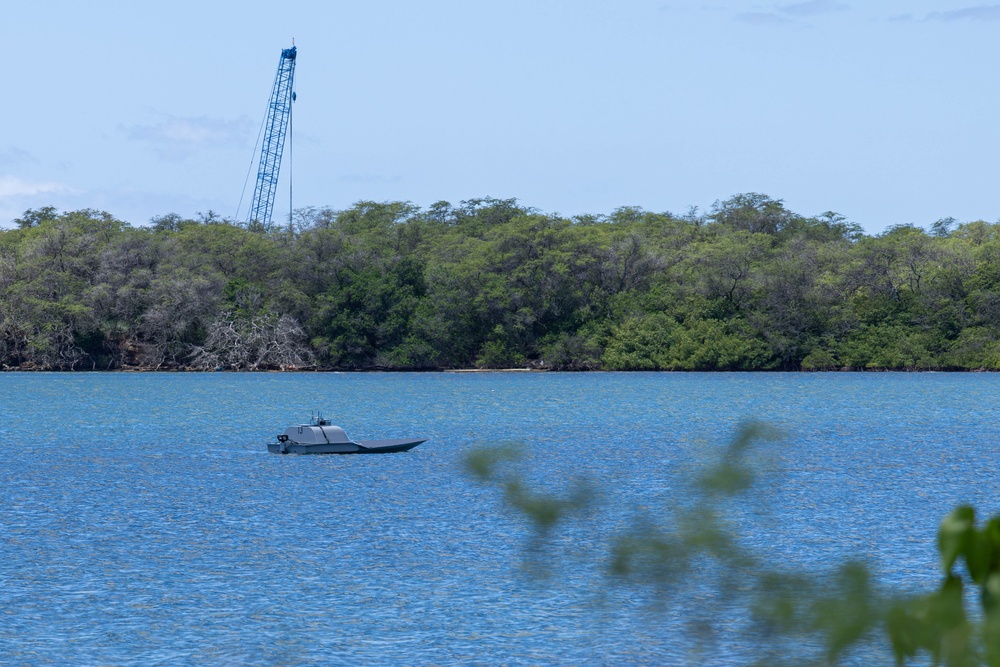
MARTAC's May 5, 2026 release reports a 192-hour mission by a T38 Devil Ray owned and operated by Naval Air Warfare Center Weapons Division's Point Mugu Sea Range through its Blue Water Instrumentation effort. The company describes no chase boats or escorts, navigation around stationary and moving contacts, and an average speed just above four knots.
The release says the vessel intentionally alternated single-engine operation for two days approximately 400 nautical miles offshore to assess endurance and extend loiter time. It explicitly distinguishes this from a failure scenario. The distance describes the offshore operating location, not the total distance traveled or the location of the nearest possible recovery asset.
MARTAC describes the T38 as a 38-foot carbon-fiber vessel. It also characterizes the avoidance of stationary and moving contacts during this run as a demonstration of COLREG-compliant autonomy. That is the supplier's account of the observed mission, rather than proof of compliant behavior in every traffic situation.
These are supplier-reported results. They establish a concrete test account worth examining, while detailed logs and independent acceptance evidence would be needed to assess broader reliability claims. The Navy instrumentation context also matters: supporting a range mission is a meaningful use case, but its requirements should not be treated as identical to every prospective operational deployment.
Persistence exposes different questions than a short transit
A short demonstration can show that a vessel follows a route and returns useful information. A longer run creates opportunities to examine behavior across changing conditions, accumulated equipment use and extended separation from hands-on support. Evaluators can ask whether observations remain consistent, whether resource estimates remain useful and how the system communicates its own limitations.
The relevant evidence goes beyond the duration printed in a headline:
- Continuity: which functions remained available throughout the mission?
- Intervention: what direction, monitoring or remote assistance was provided?
- Environment: what conditions were encountered, and which were outside the test?
- Configuration: which hardware, software and payloads produced the result?
- Recovery: what arrangements existed if the vessel could not continue?
No onboard crew and no escort are meaningful conditions. They should still be distinguished from an absence of all remote supervision or support. The test record should make those relationships visible so that another program can judge whether the result transfers to its own mission.
Efficiency testing and fault recovery answer different questions
Intentional reduced-propulsion operation can reveal fuel consumption, station-keeping behavior and endurance tradeoffs. A propulsion fault introduces additional uncertainty: detection, isolation, remaining capability and the safety of continuing. Both deserve evaluation, but success in the first does not establish success in the second.
For a program office, this distinction improves the test plan. Preserve the useful endurance result, then define separate evidence for abnormal conditions. Evaluate whether operators receive an accurate system state, whether approved limits remain enforced and whether the recovery procedure works. The intended response should be established through the platform's safety and operating processes.
The broader lesson is that endurance, autonomy and mechanical reliability are coupled. Software cannot compensate for every physical limitation, and a capable hull does not make its control system dependable. Propulsion, power, seakeeping, sensors, communications and onboard processing all contribute to the result.
Carry the evidence into acquisition without inventing a universal test
The T38 account can inform questions for other uncrewed surface vessel programs. It does not establish their contractual acceptance criteria or selection schedule. Different vessel sizes, payloads and operating concepts require different evidence, even when persistence is a shared goal.
For a prototype evaluation, ask the supplier to connect its demonstration to the proposed requirement:
- Identify which mission functions were demonstrated and which remain untested.
- State the configuration and environmental boundaries of the result.
- Provide the relevant logs and describe any remote intervention.
- Explain how maintenance and replenishment would work over repeated missions.
- Identify the additional tests needed before the intended deployment.
That comparison is more useful than ranking platforms solely by duration or maximum speed. A mission may require long loiter, higher transit speed, substantial payload power or particular handling characteristics. The tradeoffs need to be explicit rather than hidden behind a single endurance figure.
The onboard software must fit the vessel
Persistent operation increases the importance of local monitoring and predictable behavior when communications are limited. The engineering task is to keep the vessel within approved operating boundaries while reporting a reliable picture of its status. That requires adequate processing, power, thermal management and access to trustworthy sensor data.
Verification should include the interaction among those resources. A payload change can affect power demand; a software update can alter processing load; an additional sensor can change both data volume and maintenance needs. The accepted configuration must remain traceable as the platform evolves.
Industrial competitiveness therefore depends on the complete system and its support model. A modular architecture helps only when interfaces, configuration control and acceptance evidence support the promised changes. Repeatable operations require spare parts, trained personnel, recovery arrangements and a realistic maintenance schedule alongside the autonomy software.
The T38 mission gives the discussion a concrete example of extended offshore operation. Its strongest contribution is the opportunity to ask better questions about persistence and to demand comparable evidence across repeated runs.
Sources and further reading
Spartan X's engineering and logistics practices connect autonomous performance to sustained operations: a defined configuration, credible test evidence and a support plan that accounts for the vessel's real mission demands.