Why C2, Not the Jammers
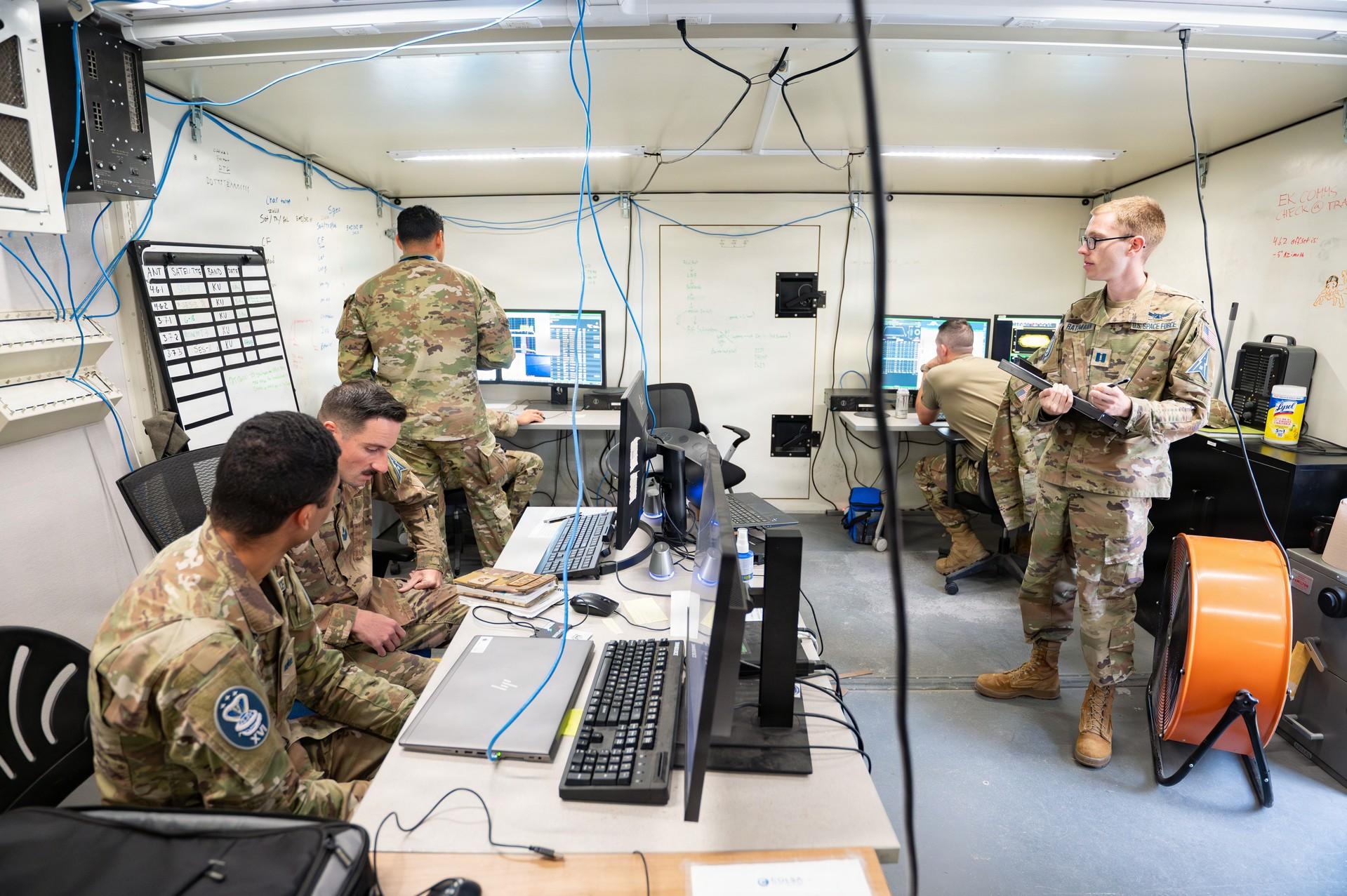
Space electromagnetic warfare capability currently sits on a problem that hardware upgrades alone cannot fix: fragmentation at the command layer. The Space Force operates multiple EW systems — the Remote Modular Terminal (RMT), Bounty Hunter, and the Counter Communications System (CCS) Meadowlands — each with its own interface, tasking pipeline, and operator workflow. As the force proliferates more geographically dispersed systems, adding platforms without a common command layer compounds crew workload.
SEWOL addresses this directly. According to the November 10 SSC press release, operators will gain access to a unified Common Operating Picture to orchestrate hundreds of remote EW systems, drastically reducing crew workload and accelerating decision-making. An earlier 2025 request for information, as described by ExecutiveGov, placed the ambition in broader terms: enabling operators to command a globally dispersed fleet concurrently across the radio frequency spectrum. The means in both cases is a single cloud-native application replacing the current fragmented toolset.
The architectural bet is explicit. Col. Angelo Fernandez, commander of Combat Forces Command's Mission Delta 3 for Space Electromagnetic Warfare, said at the award announcement: "In modern warfare, software is the decisive weapon, and we must be able to change our tactics at the speed of the threat." That framing defines the problem: the systems exist; the bottleneck is how fast operators can retask them when the adversary changes their behavior.
This is the right problem to solve. EW advantage in a contested environment is not about raw transmit power — it is about the speed, coordination, and adaptability of the C2 loop that sequences the systems. Building that loop in software, on a common cloud architecture, is the correct architectural decision. What matters now is whether the acquisition structure delivers it.
The Acquisition Mechanism: Fly Before You Buy
SEWOL moved to the Software Acquisition Pathway (SWP) and is using the Space Enterprise Consortium's Other Transaction Authority (OTA) for the Phase I awards. The choice is deliberate. SEWOL program manager Maj. Dennis "Nomad" Sieber explained it plainly: "This is not a paper-based competition; we are paying these vendors to build working software so we can see what their teams are truly capable of."
What the Phase I evaluation is actually measuring is not just whether each vendor can build a working prototype in three months — it is whether each vendor's development team and software architecture can deliver usable capability in a hands-on environment with government technical experts and operational users. The evaluation is explicitly performance-based.
Each vendor must deliver:
- A core software framework for C2 of the Space EW fleet
- Mission applications running on that framework
- A software development kit (SDK) enabling future capability additions
The SDK requirement is architecturally significant. It signals that the Space Force expects to add capability incrementally after initial delivery — which means the winning vendor's architectural choices about APIs, data models, and plugin interfaces will constrain what future contractors and government developers can build. The down-select picks not just a product but a platform.
What MOSA Buys — and What It Does Not
Col. Bryon McClain, acting Portfolio Acquisition Executive for Space Combat Power, cited both OTA competitive prototyping and Modular Open Systems Approach (MOSA) standardization as the mechanisms for avoiding vendor lock: "By leveraging Other Transactions and a competitive prototyping phase, we break vendor lock and harness the full power of commercial innovation. Additionally, common interfaces and Modular Open Systems Approach (MOSA) standardization ensure we are building a system that is as agile as the threats it is designed to counter."
MOSA calls for documented open interfaces at key boundaries — hardware-to-software, subsystem-to-subsystem — so that components can be replaced without full-system rework. Applied rigorously to SEWOL, this should mean the winning vendor exposes the RMT, Bounty Hunter, and Meadowlands CCS through standardized interfaces rather than proprietary connectors.
What MOSA does not resolve is architectural lock at the application layer. Once one vendor builds the core framework — the data model, the event bus, the state management approach, the common tasking language — that architecture becomes the integration target for every future addition. Replacing the framework later requires migrating all mission applications built against it. The SDK the winning vendor ships becomes the de facto standard, regardless of what the MOSA contract language says about component boundaries.
The mitigation the government can pursue is data rights and interface ownership: requiring that the core data model, the C2 protocol specification, and the SDK interface contract be delivered as government-purpose-rights materials. That would allow a future competitive recompete — or a government-developed alternative implementation — to target the same interfaces without starting from scratch. Whether the SEWOL program is requiring this in the Phase I agreements is not publicly stated. The Phase I evaluation provides one piece of relevant evidence: if multiple vendors independently converge on compatible interface designs, that would suggest true portability; architectural convergence only under a single vendor's proprietary SDK would not. That is what to look for in Phase I results before the down-select.
This is not a reason to reject the approach. Competitive prototyping followed by a down-select is a reasonable acquisition model for a software C2 system where the design space is not fully understood in advance. But the program's technical leadership and future integrators should enter the post-down-select development phase with a clear view of what the winning architecture will constrain, not just what it enables.
The Integration Sequence and Its Implications
SEWOL integrates hardware in a planned sequence, as laid out in the 2025 request for information. The Remote Modular Terminal is first; Bounty Hunter and the Meadowlands CCS follow. Additional future SEW systems will be added beyond those three.
The sequencing creates a practical asymmetry: the winning vendor will develop the operational system with RMT integration as the primary proof point, while Bounty Hunter and Meadowlands integrations follow. For programs that depend on those later integrations — particularly the Meadowlands fleet, which has a separate sources-sought process covering sustainment of up to 56 systems — the SEWOL down-select timeline matters. The three-month Phase I ends in approximately early February 2027 (based on the November 10 award announcement; agreement start dates are not public); post-down-select development will determine when Meadowlands operators gain access to the unified COP.
That dependency chain also means that Meadowlands sustainment planning cannot be evaluated independently of SEWOL's post-down-select delivery schedule. A program office managing Meadowlands systems through the sustainment period will eventually work through whichever vendor's C2 architecture wins SEWOL. The integration maturity of that architecture at delivery time is a risk factor worth tracking.
Broader EW Investment Context
SEWOL is not the only recent signal about EW investment priorities. U.S. Strategic Command launched ETHEREAL FORGE in June 2026 to accelerate deployment of software-centric EW capabilities across the joint force, reinforcing that the C2 and software layers are where investment is concentrating. For the Army, the FY2027 RDT&E budget exhibits show program element 0603275A (Electronic Warfare Advanced Technology) going from $85.9 million in FY2026 to a $156.3 million FY2027 request — an increase of about 82 percent in that specific advanced-technology development line.
The Space Force's move is distinctive, though: it is not adding a new EW platform; it is replacing and aligning the command tools for its existing fleet. The impact of that investment, positive or negative, will be felt by every Guardian who operates an EW system through SEWOL after it reaches operational status.
What to Watch After the Down-Select
The evaluation after three months will test each vendor's prototype in a hands-on environment with government technical experts and operational users. Key questions the evaluation should answer — and that industry partners watching the competition should track:
- Latency and responsiveness. A cloud-native C2 system for EW operations will route tasking instructions through commercial or government cloud infrastructure. How the system behaves under degraded connectivity — a core DDIL scenario for Space Force operations — is a critical architectural test the hands-on evaluation should surface.
- SDK completeness. Does the winning vendor's SDK provide documented, stable interfaces that enable future capability additions without core framework changes? The answer will determine how effectively the Space Force can incrementally upgrade SEWOL after initial fielding.
- Interface portability evidence. Do the three vendors arrive at compatible C2 protocol and interface designs independently? That evidence is the clearest signal that the winning architecture will not create the application-layer lock-in that MOSA alone cannot prevent.
- Meadowlands integration readiness. How far each vendor's prototype gets in pre-integration planning for Meadowlands will signal schedule risk in the post-down-select development phase.
- Security architecture. SEWOL is expected to operate across geographic regions and classification levels, according to ExecutiveGov's account of the RFI. The DevSecOps environment and secure development approach each vendor brings to Phase I will carry forward into the operational system.
Decision for Program Managers and Industry Partners
If you are a program manager working on a system that SEWOL will eventually command — whether Bounty Hunter, Meadowlands, or a future EW platform — the SEWOL down-select is a decision that affects your integration architecture. The winning vendor's platform will define the interface you need to meet. Tracking Phase I evaluation results and engaging with SEWOL's program office before the post-down-select development phase begins is the right action now, not after the operational system is under contract.
If you are an industry partner considering SEWOL-adjacent work — integration, DevSecOps support, capability additions via the future SDK — the winning vendor becomes a de facto prime for the SEWOL ecosystem. Understanding which of the three architectures is most compatible with your existing capabilities is worth the investment of attention now.
The Space Force's decision to invest in the software command layer and use competitive prototyping to select the best team is the right approach. The architectural choices that follow that decision are where the operational consequences will be felt.
Spartan X's work in edge compute, software-defined integration, and DDIL-resilient architectures has direct application to exactly this problem: how mission systems behave when connectivity to centralized cloud C2 is degraded, and how to build the integration layers that let hardware platforms talk to a new software orchestration layer without full-system rework. That is the class of technical problem the SEWOL post-down-select development phase will expose at scale.
Sources and further reading
- Space Force to Tackle Electromagnetic Threats with New Unified Cloud C2 Initiative — Space Systems Command official press release, Nov. 10, 2026
- Space Force Picks Three Companies for SEWOL C2 Prototyping — ExecutiveGov, Nov. 12, 2026
- Space Force's Mystery Launches Come as It Prepares for a New Kind of Fight — ClearanceJobs, Nov. 16, 2026
- Space Force picks three firms to develop cloud software to control electronic jammer fleet — SpaceNews, Nov. 13, 2026
- SEWOL Request for Information, SAM.gov Notice 07242025 — Space Systems Command, Jul. 24, 2025
- U.S. Strategic Command Launches ETHEREAL FORGE — USSTRATCOM, Jun. 25, 2026
- Army FY2027 RDT&E Budget Estimates, Vol. 3 — PE 0603275A Electronic Warfare Advanced Technology — Office of the Assistant Secretary of the Army (Financial Management and Comptroller)
- Space Force Seeks Industry Input on Sustaining Meadowlands Jamming Fleet — GovConWire, Oct. 19, 2026