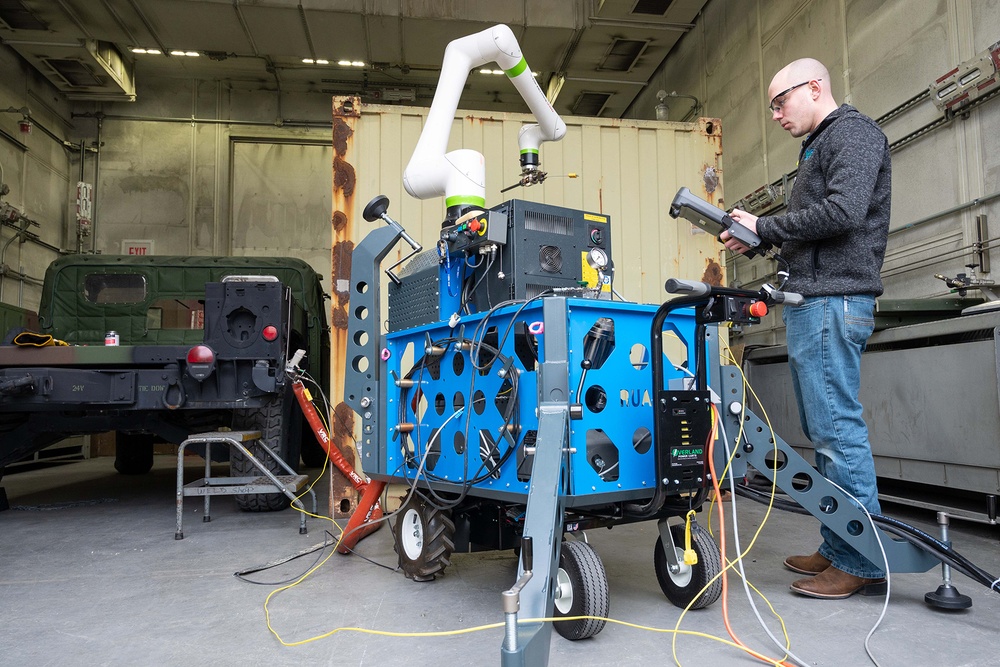
Three mechanisms that give the proposal substance
H.R. 9091, the Defense Industrial Base Advanced Manufacturing Enhancement Act, proposes amendments to Section 1842 of the FY2026 NDAA. It builds on the plan already required there rather than creating the entire planning obligation from scratch. Introduced bill text
The proposed sequence is specific:
- Share the plan: within 180 days after enactment of the new subsection, Acquisition and Sustainment would submit it to the existing collaborative forum, DLA, and congressional defense committees.
- Organize implementation: forum members would establish a working group or other appropriate organization to develop or identify manufacturing solutions likely to produce the identified items within 24 months of the group's establishment.
- Make shortages visible: within 60 days after receiving the plan, DLA would flag the relevant critical readiness items on its No Bid Solicitation List, which tracks solicitations receiving no bids or no responsive offers within required timelines.
Those deadlines would begin from the events specified in the legislation, not from the bill's introduction. Their value is the connection between a plan, an execution mechanism, and information that can reach potential producers.
For a program office, that connection can turn a recurring shortage into a tractable decision. The missing part may be obsolete, available only from one source, uneconomic at the requested quantity, or held up by inadequate technical data. Additive manufacturing is one possible response; software-controlled machining or another qualified process may be better. The manufacturing route should follow the part's requirements and the actual cause of the shortage.
Qualification activity already provides a foundation
The proposal sits alongside concrete efforts to expand qualified supply. DLA's Joint Additive Manufacturing Acceptability IV pilot selected 24 companies sharing a maximum $9.8 million firm-fixed-price indefinite-delivery/indefinite-quantity arrangement. The awards were made February 25 and announced March 5, 2026, with a one-year base and four one-year options. The shared ceiling is not $9.8 million for each company, and pilot participation does not establish qualification for every future part. Official contract announcement
America Makes also launched two project calls on March 5 with combined funding exceeding $35 million. One addressed organic-industrial-base modernization; the other, a $10.5 million supplier-qualification effort, anticipated up to 30 awards and included training and audits for metal additive manufacturers. Its focus on process controls and qualification is directly relevant to moving from a promising print to a repeatable supply source. The published April application deadlines are historical. America Makes project calls
The important measures are qualified parts, credible additional sources, shorter delivery times, and readiness recovered.
Two repairs show what repeatable execution needs
The Navy's Bataan example combined onboard production with engineering reach-back. NAVSEA reported that the ship fabricated and replaced a de-ballast air-compressor sprayer plate in five days in 2023. Engineers refined the design and securely transferred manufacturing instructions to the ship. The printer was only one element in a functioning support arrangement. NAVSEA's Bataan account
An April 2026 NAVAIR account described a cracked F-15 cockpit cooling duct that initially threatened three to four months of downtime. Air Force maintainers worked with Marine Aircraft Logistics Squadron 36; the Marines printed, delivered, and fit-checked two prototypes within 12 hours. The account reports that the approved repair returned the aircraft far earlier than projected and that the updated printing requirements entered Air Force technical publications. That last step makes the example particularly useful: the knowledge became available for subsequent repairs. NAVAIR's F-15 account
Neither case establishes that every delinquent part can be printed quickly. Both show the importance of engineering authority, usable technical data, capable personnel, and a documented acceptance path. A standing process should make those resources easier to assemble before the next urgent shortage.
What a supplier should bring to the parts review
An effective submission explains the entire route to an accepted item:
- The shortage: part identifier, affected equipment, demand history, existing lead time, and consequence of continued nonavailability.
- The production method: why the selected process fits the geometry, material, service environment, and anticipated quantity.
- The qualification evidence: approved design basis, process parameters, material records, inspection methods, and the authority responsible for acceptance.
- The delivery plan: capacity, tooling, workforce, post-processing, inspection bottlenecks, and realistic first-article and recurring delivery dates.
- The data arrangement: ownership and permitted use of drawings and build files, configuration control, secure transfer, and retention of manufacturing records.
This is also where economic discipline belongs. A part that can be printed may still be cheaper or faster to machine, repair, or procure conventionally. Compare the alternatives using readiness impact and total qualification and delivery cost, rather than the printer's cycle time alone.
Trusted production includes the machine supplier
A separate enacted provision, FY2026 NDAA Section 849, restricts agency procurement of covered additive-manufacturing machines beginning December 18, 2026. Coverage turns on defined companies, including listed entities, covered-nation domicile, or unmitigated foreign ownership, control, or influence; it also reaches specified related services and equipment. The law includes an exception for designated intelligence, electronic-warfare, and information-warfare purposes. Its actual scope matters when screening a manufacturing investment. Enacted Section 849
Beyond that procurement rule, a resilient workflow should account for software integrity, material provenance, machine maintenance, and controlled technical data. A supplier's evidence should make it possible to establish what was built, on which configuration, from which approved inputs, and under whose authority.
Watch the implementation language
Track the introduced bill and any later legislative vehicle for changes to the reporting recipients, working-group responsibility, production horizon, and no-bid notation. A proposal may change substantially before enactment. The operational question remains consistent: does the final arrangement connect identified shortages with funded, qualified production and an organization responsible for completing the work?
That is a stronger measure of progress than a count of studies, printers, or demonstrations. A useful standing process produces parts that the supply system can repeatedly buy and the maintainer can confidently install.
Sources and further reading
- H.R. 9091 introduced text
- DLA JAMA IV contract announcement
- America Makes modernization and qualification calls
- NAVSEA: Bataan sprayer-plate repair
- NAVAIR: F-15 cooling-duct repair
- Section 849 procurement restriction
Spartan X's logistics and program-execution work connects critical-part requirements with engineering decisions, supplier evidence, and accountable delivery. That coordination is what turns an available manufacturing technology into a practical readiness resource.