Why the Marine Corps needs this vessel in the first place
Force Design (originally Force Design 2030) fundamentally restructured Marine Corps logistics. Per the CRS assessment of the initiative, the Corps eliminated heavy bridging equipment and most towed cannon artillery, and phased out most of the legacy logistics capability it had built for sustained land operations, in favor of a leaner force designed to persist in dispersed island-chain positions across the Indo-Pacific. That shift creates a specific logistics problem: small Marine units holding key maritime terrain cannot be resupplied through conventional means when adversary strike and sensor systems make surface ships and manned aircraft unacceptably vulnerable.
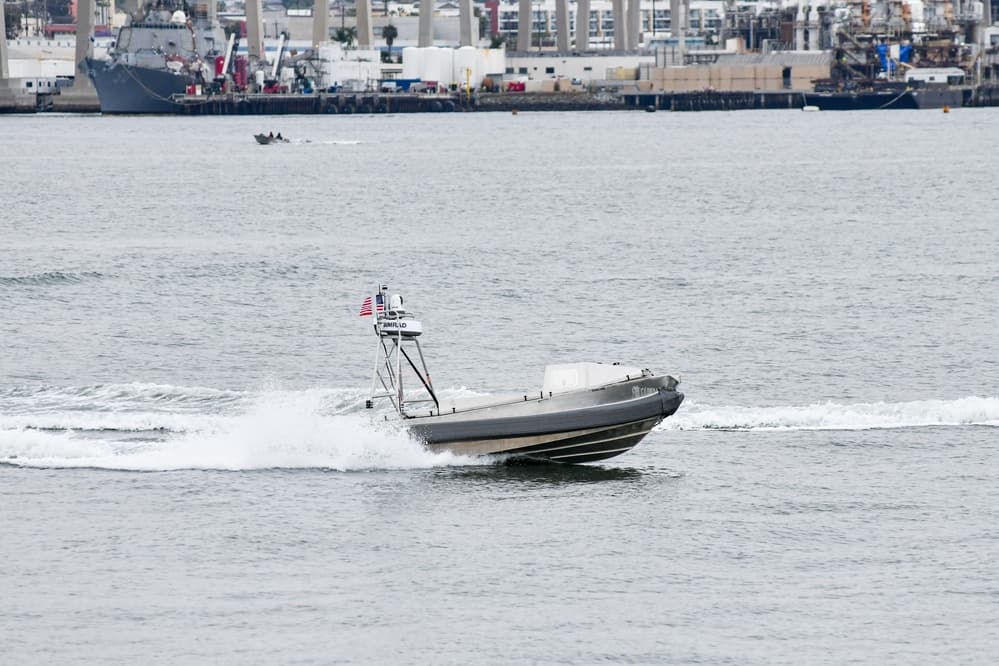
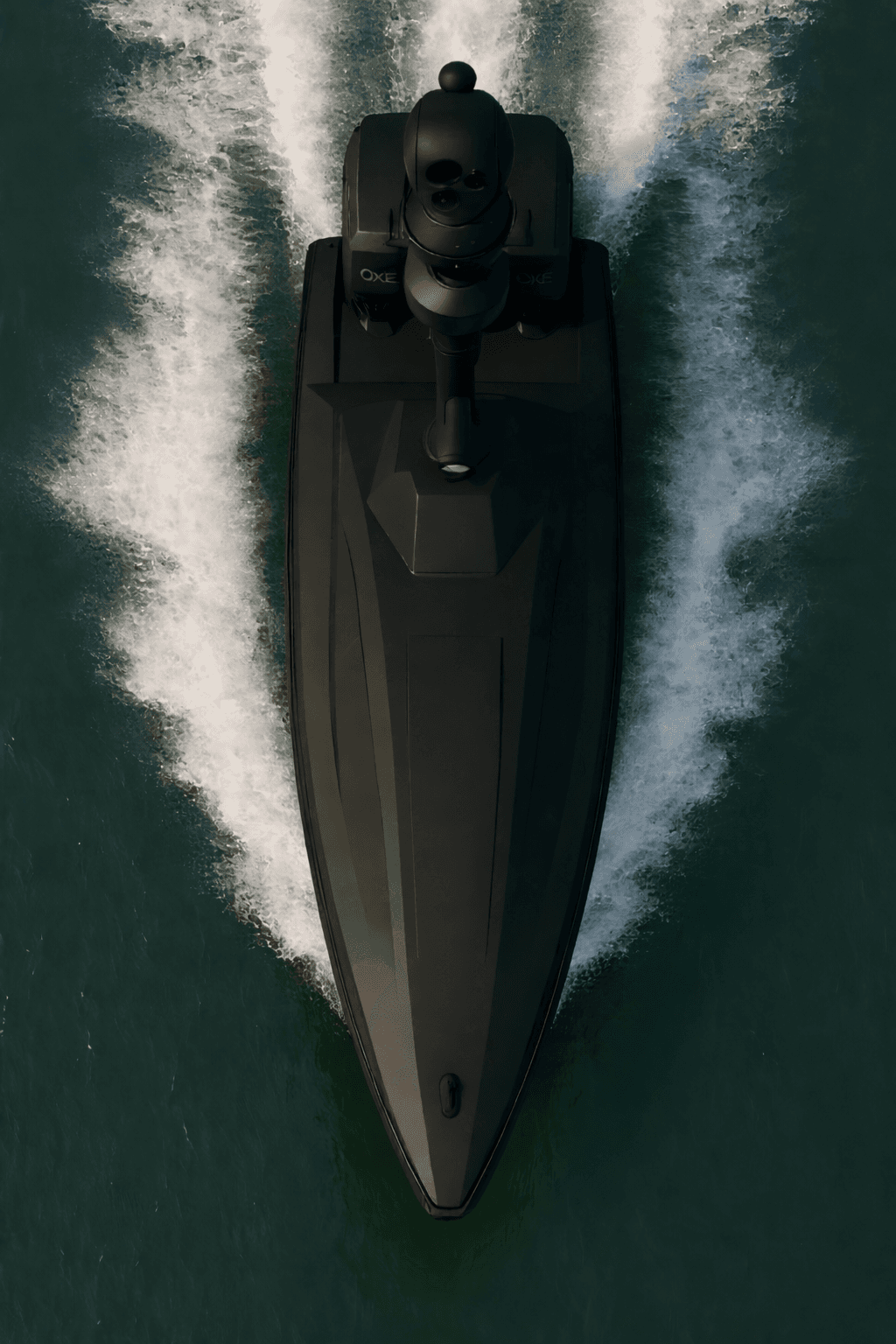
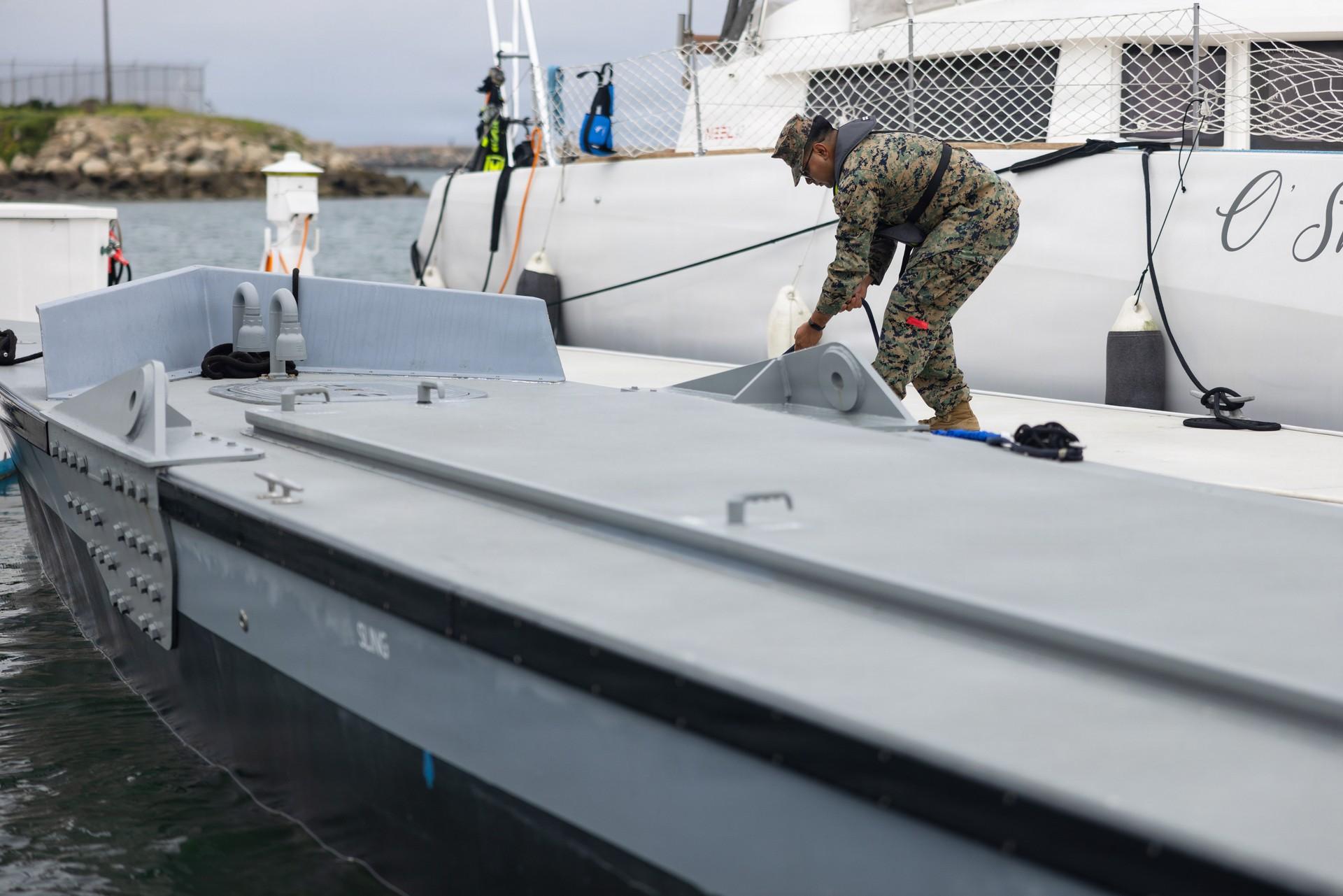
The ALPV is the Corps' answer to that problem in the maritime surface layer. It is a semi-submersible autonomous vessel — the design borrows its low-profile running form from narco-boat semi-submersibles that run near-awash to avoid detection. Brig. Gen. Simon Doran described the design lineage plainly in remarks DefenseScoop reported in March 2026: "Truth be told, this is just a narco boat." The remark, originally made in 2024, was neither dismissive nor embarrassing — the narco-trafficking community solved a real tactical problem, and the Marine Corps is engineering that solution into an autonomous military logistics platform.
DefenseScoop reports the vessel should carry at least 18,000 pounds across up to 2,000 nautical miles in moderately rough seas, with humans able to take over control; Autonocion's coverage of the solicitation gives the full range as 1,000 to 2,000 nautical miles in sea state 5, with an operator able to take over by remote control for the first and last mile. DIU has not disclosed individual award values, quantities, or precise award dates. The October 2025 Force Design Update lists the ALPV as "transitioning to a program of record to provide autonomous long-range logistics distribution." The awards do not state how the demonstrations relate to that transition; the performance data they produce should logically inform it.
What the multi-vendor structure changes
DIU's Nov 9 announcement notes the Corps "has previously prototyped several ALPV variants." Prior testing has been documented at Camp Pendleton, Camp Lejeune, and Project Convergence Capstone 4, among other venues. The DIU's own justification for going back to competition is direct: "we must move faster while reducing costs," and opening to commercial autonomy solutions and vessel designs allows access to capability the existing prototype base may not offer.
Running three prototypes in parallel is designed to do two things a serial prototype history makes harder. First, it creates genuine design comparison data within a single evaluation window. By the time the demonstrations are complete, the program will have performance evidence — cargo capacity, range, sea state tolerance, autonomy reliability, maintenance burden — from three different architectural approaches within a comparable window. That is a faster path to informed source selection than serial testing permits.
Second, it creates competitive pressure on cost and production readiness. Saronic has existing Navy OTA relationships — including a September 2026 production OTA for ten Medium Unmanned Surface Vessels — and has demonstrated autonomous surface vessels in prior programs. Sea Machines has a production history with autonomous vessel control systems, including the SM300 that already drives the Corps' current low-profile boat. Rudder Industries is a first-time Department of War partner — its selection signals that DIU was willing to bring in commercial talent without a prior DoW track record if the technical approach warranted it. The presence of a first-time partner alongside established defense suppliers changes the negotiating dynamics for any follow-on production OTA.
What the 180-day demonstrations need to prove
The demonstration timeline is a window, not a fielding milestone. What the demonstrations need to establish is not whether the vessels float and navigate — the existing testing record confirms that is achievable — but whether the specific performance thresholds for Force Design operations are within reach at defensible cost.
Three requirements deserve particular scrutiny.
Range and payload together. DefenseScoop reports at least 18,000 pounds for up to 2,000 nautical miles in moderately rough seas; Autonocion's coverage of the solicitation specifies six 3,000-pound Joint Modular Intermodal Containers (or two larger containers) and 1,000 to 2,000 nautical miles fully loaded in sea state 5. Those reported requirements are individually challenging: Leidos said in March 2024 its vessels were designed to carry up to five tons over 2,000 nautical miles — below the new reported payload requirement. Meeting the full payload with range in a production-representative design at acceptable acquisition cost is a harder combined constraint. Demonstrating that all three vendors can approach that combination narrows the design trade space for the program of record.
Human supervision of multiple vessels. According to Autonocion's coverage of the solicitation parameters, the design would allow one operator to manage multiple vessels simultaneously, with an operator able to take over by remote control for the first and last mile; DefenseScoop confirms humans must be able to take over control. This is a human-machine interface and mission-system design challenge, not just an autonomy challenge. The vessel's autonomy stack needs to handle navigation, obstacle avoidance, environmental adaptation, and contingency responses while the human operator monitors multiple craft at once. What fails first in that model is typically the exception-handling protocol: when one vessel encounters an unexpected condition that requires operator decision, how does the human supervise the other vessels without losing track of the exception? The demonstration should produce data on exception frequency, operator workload under realistic sea conditions, and the latency of human intervention when connectivity degrades — all of which are relevant to the program of record's minimum-viable autonomy requirements.
Scuttle on command. According to Autonocion's coverage of the solicitation parameters, the vessel must be capable of scuttling itself on command. The rationale for such a requirement on a low-profile vessel is straightforward: capture by an adversary in a contested maritime environment could reveal design details, navigation protocols, or communication signatures. The engineering challenge is predictable: a scuttle system must be reliable enough to execute when commanded but fail-safe enough not to execute inadvertently. The demonstration record should show scuttle execution rate across varied conditions, not just a single command-execute test.
What can still fail
Three failure modes are worth watching through the demonstration phase.
Autonomy brittleness under degraded conditions. The 1,000-to-2,000-nautical-mile requirement implies extended operation across multiple weather windows, potential communication outages, and environmental conditions that land-based or near-shore testing does not fully replicate. As a general pattern in autonomous systems development, platforms that have performed reliably in test ranges and controlled exercises have shown unexpected failure modes in extended open-ocean operations — specific ALPV failure data are not public, but the pattern is worth anticipating when evaluating demonstration results. The program of record decision should not lock down an architecture before the demonstrations have covered multiple sea states and extended communication-denied intervals.
Integration gap at the receiving end. A crewless resupply vessel arriving at a forward position occupied by a small Marine unit needs to offload cargo in a contested environment without exposing Marines to detection or requiring a port facility. How the ALPV integrates with shore-side reception — whether that means Marine unit procedures, purpose-built offload equipment, or capability built into the vessel — is not among the publicly reported demonstration parameters. It is a gap that will need to close before the ALPV delivers its logistics proposition in a Force Design scenario. The demonstration schedule is an opportunity to begin identifying what that reception architecture requires.
Cost per unit vs. expendability threshold. Semi-submersible autonomous vessels operating in contested maritime terrain are targets. The logic of an attritable platform implies some unit losses are acceptable — a common design assumption for expendable autonomous systems. At what acquisition cost per unit does that calculus hold? To illustrate with hypothetical figures: if a vessel costs $4 million, planners may treat it as attritable in a way they would not for a vessel at $14 million. For a rough sense of scale in the autonomous vessel market, the Navy's Medium Unmanned Surface Vessel — a related autonomous vessel program — averages roughly $40 million per vessel per the September 2026 production OTA. If the demonstrations reveal that meeting the range and payload targets drives unit cost above the threshold where planners treat the ALPV as expendable, the program of record will face a requirements-cost tradeoff that the prototype demonstrations alone will not resolve.
The program of record decision the Corps has to make
The October 2025 Force Design Update describes the ALPV as "transitioning to a program of record to provide autonomous long-range logistics distribution." With these three parallel-track awards, the ALPV program enters a demonstration phase whose performance data should logically inform the program-of-record path. After the demonstrations, the Marine Corps will navigate a decision between three structural options. Through the development phase, DIU will work side by side with its DoW counterparts at PAE Maritime — CDFi, MCWL, DRPM RAS and NAVSEA CCD — producing the performance and design data that decision will draw on.
A single-vendor production OTA would maximize production learning curve benefits and simplify logistics and maintenance, but requires a defensible down-select and forfeits ongoing competitive price pressure. A dual-vendor approach preserves limited competition and allows design evolution while adding program management complexity and cost. A common-interface approach — standardizing the payload interface, communication protocols, and control architecture while allowing multiple hull designs — offers the most flexibility but requires the most investment in standards development before contracts are placed.
None of these is obviously correct. The right choice depends on data the demonstrations are designed to produce: how much performance variance exists across the three designs, how tractable the production cost curves are, and whether any of the three vendors has demonstrated a compelling advantage in multi-vessel human supervision. Making that call before the demonstrations are complete — which the program's urgency may pressure — creates the same risk that plagued earlier defense acquisition programs that locked architecture before they had design comparison data.
Useful context if you're advising a program office on this decision
The acquisition choice the Marine Corps will navigate after the demonstrations looks like this:
- If performance is roughly equivalent across all three vendors, a competitive down-select on cost and production readiness is defensible.
- If one vendor demonstrates a significant autonomy or range advantage, a sole-source follow-on OTA with that vendor is the faster path to fielding.
- If the demonstrations reveal that none of the three designs meets the reported performance requirements at viable cost, the program faces a requirements renegotiation before a production OTA makes sense.
- If the common-interface option is on the table, the question is whether the Marine Corps wants to establish the ALPV as a platform standard for the distributed logistics architecture — analogous in structural logic to how JADC2 functions as a command-and-control architecture (the comparison is illustrative, not technical) — or treat it as a one-off program solution.
Force Design explicitly names the ALPV as a logistics capability meant to let distributed forces persist in contested environments. The read that the ALPV should be treated as platform infrastructure — a standard element in a distributed sustainment architecture rather than a one-off program solution — is Spartan X analysis, but it follows from what the Force Design architecture is trying to accomplish, and it deserves consideration before the program of record is defined.
Sources and further reading
- DIU ALPV award announcement (X, Nov 9, 2026) — three-vendor award with counterpart offices named
- DefenseScoop: U.S. military seeks more ALPV capability (Mar 4, 2026) — solicitation details, Doran quote, vendor background
- Marine Corps Force Design — October 2025 update — ALPV listed as transitioning to program of record
- CRS Report R47614: U.S. Marine Corps Force Design Initiative — legislative background and logistics modernization context
- Leidos: Project Convergence Capstone 4 press release (Mar 2024) — ALPV performance intent and Capstone 4 participation
- Sea Machines: SM300 for ALPV program (May 2025) — autonomy system details
- Navy: MUSV production OTA (Sep 2026) — Saronic OTA and MUSV program context
- Ocean News & Technology: DIU awards ALPV contracts (Nov 2026) — award announcement detail
- Autonocion: ALPV solicitation specifications (Nov 2026) — solicitation performance parameters
- DVIDS: 1st MLG Marines test ALPV at Camp Pendleton — January 2026 testing imagery
- DVIDS: ALPV tests at 2nd MLG, Camp Lejeune — April 2025 testing imagery
The one-to-many supervision architecture the solicitation reportedly calls for — managing multiple semi-autonomous platforms under lost-comms conditions — is an edge compute and AI inference problem at its core. Spartan X's BRIC system is engineered specifically for forward-deployed C3 and AI inference under DDIL conditions; that design constraint is directly relevant to the minimum-viable autonomy stack this program will need to specify before program of record.