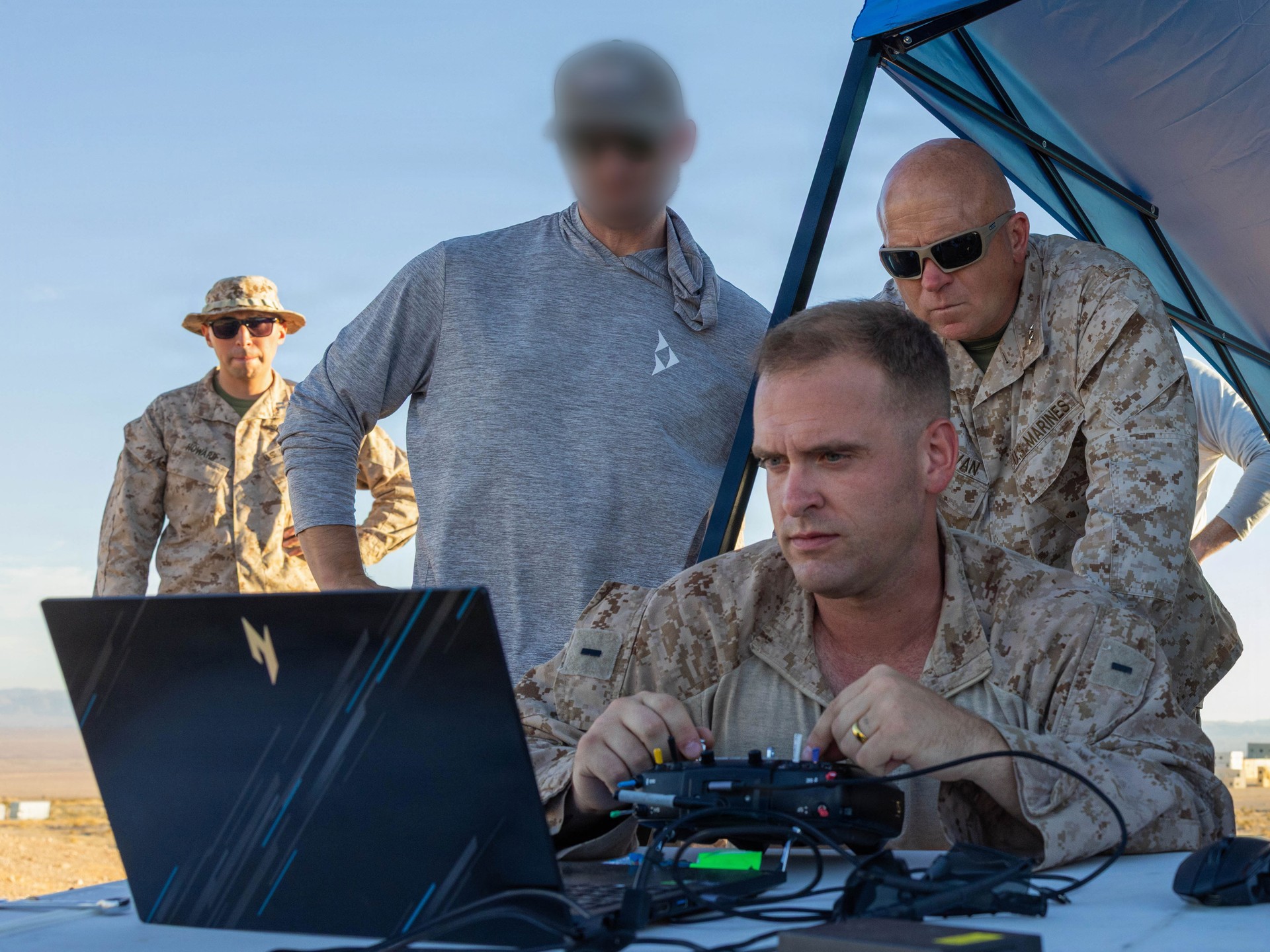
Start with what has to work offline
DDIL commonly describes denied, degraded, intermittent, and limited-bandwidth conditions. A remote outpost, a mobile command element, or a platform limiting transmissions may have very different reasons for losing access to enterprise services. The architecture should account for the actual communication profile, including planned silence and ordinary outages as well as adversary interference.
A cloud-dependent function becomes unavailable when its required connection is lost. That does not mean every cloud-supported system fails completely: a hybrid design can retain local inference, cached data, and queued work while using enterprise services for tasks that can wait.
Begin with a short mission inventory:
- Which outputs must be available during the disconnected period?
- What inputs and reference data are needed to produce them?
- How old can those inputs become before the result becomes misleading?
- What should the operator do when the system cannot meet its confidence, timeliness, or resource limits?
The answers determine what belongs on the platform. They also prevent a team from deploying a large model simply because it performs well in an unconstrained environment. A smaller task-specific model, a conventional algorithm, or a combination may meet the requirement more effectively.
Fit the model to the mission and hardware
Three common techniques can reduce deployment demands, with different tradeoffs:
- Quantization reduces numerical precision in weights or activations, such as moving from 32-bit values to an 8-bit representation. Memory and speed benefits depend on the hardware, supported operations, and calibration; accuracy must be measured after conversion. PyTorch quantization guidance
- Pruning removes selected weights or structures. A sparse model does not automatically run faster on every processor; the runtime and hardware must be able to use the resulting structure. PyTorch pruning tutorial
- Knowledge distillation trains a smaller model using information from a larger model or ensemble. It can transfer useful behavior, but the student must be evaluated for its own task and operating conditions. Original distillation paper
These techniques should be compared against an unmodified baseline on representative mission data. Report the failures that matter, rather than only an average score. A modest aggregate accuracy change may conceal a larger loss on a rare but consequential condition.
Hardware selection should include sustained inference time, memory use, power draw, cooling, startup behavior, and supported software versions. Accelerators can improve efficiency, but a peak operations-per-second figure does not establish mission throughput. Data movement, preprocessing, unsupported model operations, and thermal throttling may dominate the result.
Commercial processor suppliers, including NVIDIA, Qualcomm, and Intel, offer different computing ecosystems. The decision should turn on demonstrated workload performance and integration support, not a general claim that one chip family is suitable for every unmanned platform or portable device.
Treat the deployed model as a managed configuration
An edge deployment includes more than the model weights. Its configuration can also include the runtime, preprocessing logic, sensor calibration, reference data, permissions, and operating-system dependencies. Changing one element may invalidate assumptions tested with another.
The update process needs to work with short or unreliable connection windows. A practical design stages an update, checks its authenticity and compatibility, and applies it under approved conditions. Some systems require a maintenance window or restart; uninterrupted installation should be demonstrated where required rather than assumed.
NIST's platform-firmware resilience guidance emphasizes protection against unauthorized changes, detection, and recovery. Those principles are useful when designing the platform beneath an AI workload, while model-quality assurance remains a separate responsibility. NIST SP 800-193
A signed package helps establish origin and integrity. It does not establish that the model is accurate, that its training data were sound, or that an authorized publisher has not made a mistake. The release process therefore needs both cryptographic checks and an evaluation record.
Rollback also requires care. Restoring the previous configuration can recover a failed release, but indiscriminately accepting older signed software may reintroduce a known vulnerability. Define an approved recovery state and version policy, then test interrupted downloads, failed installation, exhausted storage, and loss of power.
Reconnection is a data problem as well as a network event
During disconnection, the system may accumulate observations, analysis products, logs, and operator decisions. When a connection returns, sending everything in arrival order may waste the available window or deliver stale information ahead of an urgent update.
The synchronization design should distinguish:
- Time-sensitive products whose operational value falls quickly.
- Source records needed to support later analysis or verify a result.
- Configuration and security records needed to establish the platform's state.
- Bulk training or diagnostic data that can wait for a better connection.
A prioritization algorithm may help, but the policy should remain understandable and testable. It needs to preserve handling restrictions, provenance, timestamps, and enough context to prevent duplicate or contradictory records from being mistaken for fresh independent observations.
The receiving system should also know when a node's picture is incomplete. A delayed synchronization must not silently imply that every participant has seen the same information. Define conflict resolution, stale-data indicators, and the authority to reconcile divergent records.
Test the operating experience, not just inference speed
The field test should combine communication loss with the other conditions that affect the platform: constrained power, environmental exposure, limited storage, and the workload of the person using it. Environmental qualification must apply to the actual integrated configuration and intended conditions.
Before acceptance, demonstrate that the operator can:
- Recognize when a result depends on stale or unavailable inputs.
- Understand the system's limitations without interpreting internal model diagnostics.
- Continue the essential task, or follow a defined fallback, when a component fails.
- Recover from an interrupted update and confirm the active configuration.
- Reconnect and reconcile data without losing the history needed to explain prior outputs.
Training should match the real staffing and mission context. A capability that needs continuous intervention from its developers has a different support burden from one that trained operators can manage in the field.
The strongest edge architecture preserves useful local operation while taking advantage of enterprise resources when available. Its value is demonstrated by the mission it sustains through constrained conditions, with limits that the operator can recognize and act on.
Sources and further reading
- PyTorch: practical quantization
- PyTorch: pruning methods
- Hinton, Vinyals, and Dean: knowledge distillation
- NIST: platform firmware resilience
Spartan X's BRIC offering centers on deployable edge computing, intelligence analysis, and an austere data hub for DDIL conditions. Its engineering and cybersecurity practices address the surrounding integration work: dependable local processing, controlled software changes, and usable information when connectivity returns.