What TiC 1.0 Actually Tested
Army Chief of Staff General Randy George launched Transforming in Contact in 2024, initially selecting the 2nd Brigade Combat Team, 101st Airborne Division at Fort Campbell, Kentucky as the first unit. The operational premise was direct: move technology into soldiers' hands, run it through real training conditions, and let formation feedback drive requirements — instead of requirements driving technology selection years before soldiers ever touch it.
The early results surprised the program's skeptics. The 2nd BCT/101st eventually recorded the highest retention rate in the 101st Airborne Division, with the higher operations tempo and accelerated training schedule improving rather than degrading morale. The initiative was testing technology; it wound up testing organizational assumptions about what soldiers want from their work.
Tactically, TiC units applied lessons from the conflict in Ukraine systematically: improvements to UAS employment methods, electronic warfare posture, ground mobility, deception operations, command and control survivability, and counter-UAS protocols. The 1st Armored Brigade Combat Team, 3rd Infantry Division, became the first TiC armored unit to run a Combat Training Center rotation under the initiative, moving through Combined Resolve 25-2 at the Joint Multinational Readiness Center in Hohenfels, Germany in May 2025.
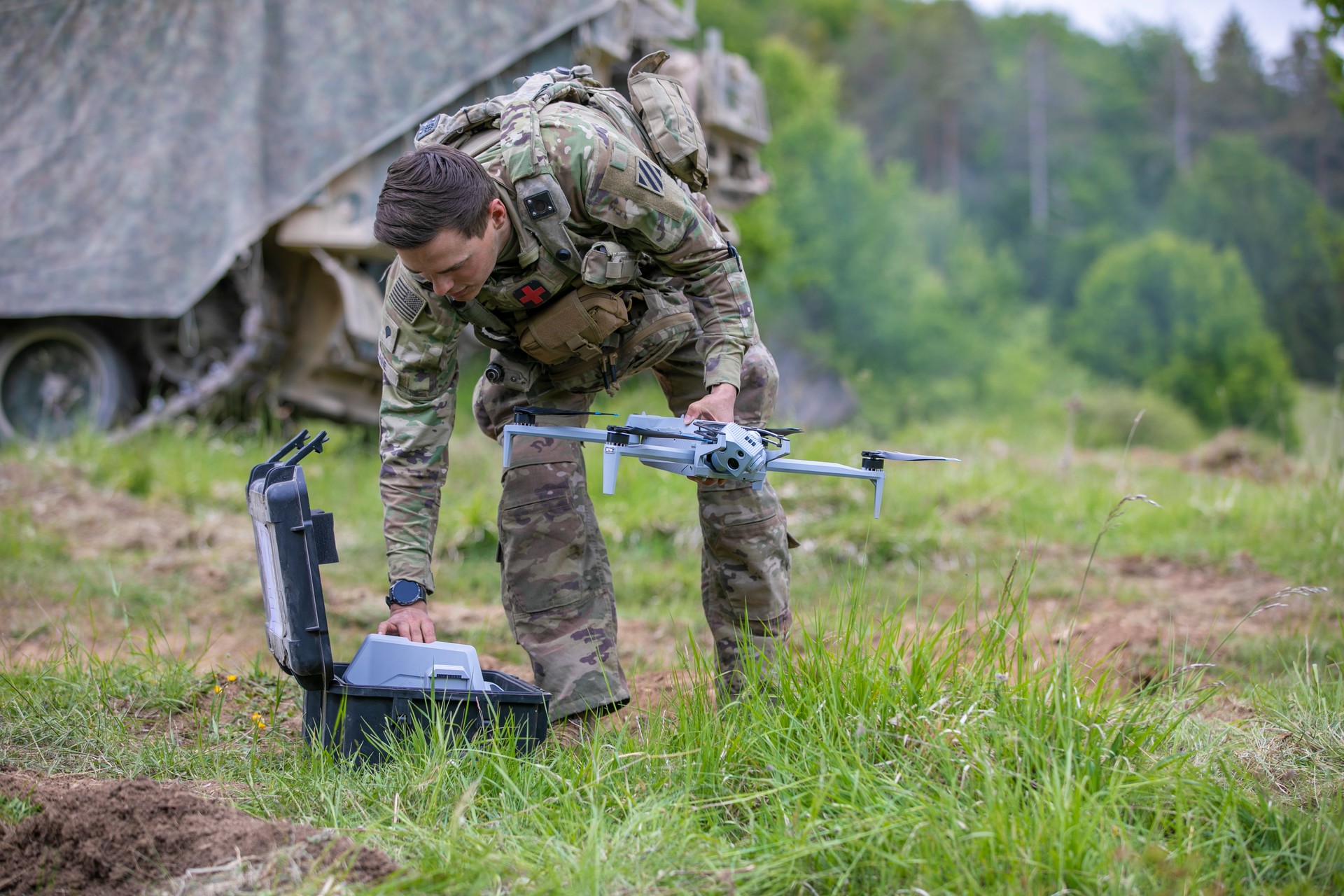
The Combined Resolve 25-2 rotation made TiC's technology integration visible in detail. Soldiers from 5-7 Cavalry operated the Skydio X10E4TT drone for reconnaissance and targeting. The EnforceAir 2 counter-UAS software-defined radio detector supported protection operations. The Beast+ electronic warfare system — an experimental EW capability — was evaluated alongside commercial UAS assets in conditions meant to replicate near-peer threat environments. These were not showpieces; they were assessed under exercise pressure, and the results fed directly back into requirements conversations.
TiC 2.0: The Autonomy Problem
The second iteration of TiC was announced at the AUSA Annual Meeting in October 2024, with unit-naming details confirmed in early 2025, and it carries a different organizational footprint and a harder technical problem at its center.
The units named for TiC 2.0 include the 25th Infantry Division and the 101st Airborne Division at the division level, plus the 2nd Cavalry Regiment (a Stryker unit based in Europe) and 1st Brigade, 3rd Infantry Division as the armored formation. The scope also expands to Multi-Domain Task Forces, Army special operations units, Army National Guard formations, and enabling units such as artillery and air cavalry brigades — not just the BCT-centric framing of TiC 1.0.
The technical shift is the more consequential change. TiC 2.0's stated priority is breaking the one-to-one relationship between operator and machine — particularly for unmanned aerial systems. A formation where each drone requires a dedicated operator scales poorly under the attrition and bandwidth constraints of large-scale combat operations against a near-peer adversary. The Army wants to understand what it actually takes to run autonomous or semi-autonomous UAS missions at the scale the battlefield demands, with the operator managing task-level objectives rather than flight-level inputs.
The 101st Airborne's Multifunctional Reconnaissance Company makes the organizational design explicit. Built around three hunter-killer reconnaissance platoons, a drone-and-EW platoon, and a robotics and autonomous systems platoon, the MFRC is a test article for what a formation that integrates these capabilities as organic assets — rather than attached enablers — actually looks like in practice.
The Acquisition Pathway Behind TiC
The Army built a parallel acquisition mechanism to match TiC's tempo rather than forcing TiC feedback into the traditional acquisition calendar.
The Pathway for Innovation and Technology consolidates the Army's process for moving TiC-validated capabilities into program-of-record territory. PIT's stated operating timeline is 12 to 18 months from validation to transition to Portfolio Acquisition Executives. For FY2026, the priority threads include integrating autonomous counter-UAS capabilities, developing open systems architectures for command and control, providing AI-enabled decision support, and fielding scalable electronic warfare. In the All Arms Maneuver category, the priorities are autonomous breaching, terrain shaping, and launched effects. In Adaptive Sustainment, the priorities are autonomous refueling, rearming, and medical triage.
These are not aspirational programs. PIT's 12-to-18-month timeline means that capabilities entering the validation pipeline in FY2026 are candidates for FY2027-FY2028 fielding decisions. The window to influence those decisions by demonstrating integrated performance is not open indefinitely.
xTechOverwatch: The Competition the Calendar Drives
The xTechOverwatch competition illustrates how TiC and PIT interact. Hosted by U.S. Army Transformation and Training Command at the Bush Combat Development Center in Bryan, Texas on October 27–29, 2025, the competition evaluated 40 selected industry teams integrating autonomous unmanned systems with active TiC formations. Twenty teams were selected to continue working directly with TiC formations from January 2026 through July 2027, with $1 million in cash prizes and $40 million in follow-on award authority backing the selections.
The structure of xTechOverwatch is instructive for contractors. Selection required demonstrated integration with soldiers in field conditions, not paper performance against a requirements document. The 18-month follow-on engagement covers the same period as the FY2026-FY2027 PIT transition window. Companies inside that cohort are building the performance record and soldier-level relationship that PIT acquisition decisions will use. Companies outside it are working against that established baseline.
The broader innovation ecosystem reinforces this dynamic. The Catalyst, Pathfinder, and Accelerating FORCE programs have produced more than 1,800 Catalyst submissions and 26 Pathfinder-funded projects with 36 academic and small-business partners. FY2026 field testing is underway with U.S. Army Special Operations Command, Indo-Pacific Command, Central Command, the Joint Multinational Readiness Center, and U.S. Army Europe and Africa. One concrete output: the BISON platform — Buildable Innovation Shop for Operational Needs — a mobile, modular manufacturing system enabling UAS production and repair at the point of need, now fielded across CENTCOM and Special Forces units. That is a capability with a service delivery mechanism built into the concept; the product and the sustainment model traveled together through the innovation pipeline.
The EW Integration Problem TiC Surfaces
Electronic warfare is not separable from the autonomous systems problem. The Beast+ system and the EnforceAir 2 SDR at Combined Resolve 25-2 were not isolated experiments — they were responding to the same tactical reality: a drone-dense environment against an adversary with EW capabilities requires that each system understand the electromagnetic conditions it is operating in and adjust accordingly.
The Army has committed to providing TiC formations with EW prototypes at the division level, a formal acknowledgment that EW is no longer a supporting function arriving at echelon — it is an organic need at the brigade and below. The Army's FY2026 PIT priority for "scalable Electronic Warfare" reflects this: the requirement is not for a single EW system but for EW capability that scales in the same way autonomous systems do, without requiring a dedicated operator pool that isn't available.
This creates a compound integration requirement that a narrow UAS capability or a standalone EW system cannot satisfy independently. The formation needs platforms that are aware of the electromagnetic environment, behave predictably under EW disruption, and support (rather than compete with) counter-UAS protocols. Testing that integration in an exercise environment before a program review is the only way to demonstrate it credibly.
What This Means for Defense Contractors
Four things are true about the TiC acquisition environment that do not appear in a standard market research read:
Position is built before the RFP. The xTechOverwatch cohort's 18-month engagement runs through mid-2027. Those companies are establishing the performance record, the institutional relationships, and the requirements inputs that PIT acquisition decisions will draw on. Contractors entering through a response to a future solicitation are competing against that established baseline.
Soldier-validated integration beats specification compliance. TiC units generate direct feedback that shapes requirement language. A capability that performed well in a Combined Resolve rotation or a Pegasus Forge exercise has something a lab demonstration cannot produce: evidence that soldiers used it under realistic conditions and found it useful. That evidence survives requirements rewrites.
Autonomous systems are being evaluated as formation capabilities, not platform capabilities. TiC 2.0's one-to-many objective means that the unit of evaluation is the formation's effective UAS capacity, not any individual platform's specifications. A system that is excellent in isolation but requires the operator cognitive load of 2.5 dedicated personnel defeats the premise. The integration test is the mission test.
Sustainment and field repairability are part of the TiC value proposition. BISON's adoption inside CENTCOM and Special Forces is not incidental. The Army's TiC formations cannot sustain a technology integration if that technology requires depot-level maintenance or commercial network connectivity for updates. The logistics envelope is part of the evaluation.
The Army is eliminating programs that do not demonstrably contribute to lethality. That is a narrowing criterion, not a relaxation of one. Capabilities that cannot demonstrate their contribution in the conditions TiC creates — field-realistic, against contested EW environments, operated by formations rather than by specialists — are competing against capabilities that can.
Sources and further reading
- Transforming in Contact alters Army in unexpected ways, army.mil
- Next iteration of Army's 'transforming-in-contact' will focus on autonomy, DefenseScoop (Feb. 2025)
- Army to provide TiC units electronic warfare prototypes, DefenseScoop (May 2025)
- xTech Overwatch Advances Army's Autonomous Capabilities with $1M in Cash Prizes and $40M in Follow-On Awards, Army SBIR/STTR Program
- From the AAE: Transforming Army Acquisition Through the Pathway for Innovation and Technology, army.mil
- Army's Catalyst, Pathfinder, Accelerating FORCE programs drive Soldier-led innovation, army.mil
- Forging the Fast Lane: The Army Establishes the Pathway for Innovation and Technology, army.mil
- Army expanding 'Transformation in Contact' initiative to Army Guard, Army Times (June 2025)
Spartan X's AI assurance and edge inference work is directly relevant to what TiC 2.0 is exposing. Autonomous systems operating in contested EW environments need behavioral guarantees that survive signal disruption and degrade gracefully under communication loss — the same class of problem that multi-model verification and bounded autonomous behavior analysis addresses. Demonstrating that evidence in conditions resembling what TiC exercises impose is the standard the Army is implicitly setting.