Why cislunar isn't just more space
Geostationary orbit sits at roughly 35,786 kilometers above Earth's surface. The Moon averages about 384,400 kilometers. Cislunar space—the volume between GEO and the Moon—is not an extension of the domain the Space Force already operates in. It's functionally a different operational problem.
Three characteristics define the difference:
Light-travel latency. A command sent from a ground station takes approximately 1.28 seconds one-way at lunar distance (384,400 km / 299,792 km/s). That's a 2.6-second round-trip minimum, before you add processing time. AFRL notes that cislunar distances require more on-board capability because reliable round-trip command cycles are not feasible at these ranges. Advanced Space, the prime contractor for Oracle-P, confirms that at the Earth-Moon L1 point, communications may be less frequent and at lower data rates than near-Earth missions, requiring satellites to perform substantial on-board analysis before downlink. For human-in-the-loop tasking against a maneuvering object, those combined constraints make direct oversight impractical. Custody tracking in cislunar space strongly favors satellites capable of making and acting on decisions independently during contact gaps.
Orbital predictability. Geostationary satellites are, by definition, in stable equatorial circular orbits. Ground-based SSA for GEO works because an object at a known slot can be catalogued and revisited on a predictable schedule. In cislunar space, the combined gravitational influence of the Earth and the Moon creates unstable trajectories and complex dynamics that make predicting an object's future position from a ground-based observation substantially more difficult than in GEO.
Ground station geometry. A cislunar satellite may spend extended periods beyond the coverage of any single ground station. As AFRL notes, cislunar distances require more capability on-board; the reduced contact frequency and lower data rates documented by Advanced Space for the EML1 environment reinforce that constraint. Building relay infrastructure is one of Cislunar Prime's three focus areas, though no operational relay architecture currently exists.
These aren't edge cases. They're the routine operating conditions for any cislunar SSA system.
What Oracle is actually testing
AFRL's Oracle Family of Systems comprises two programs with complementary scopes.
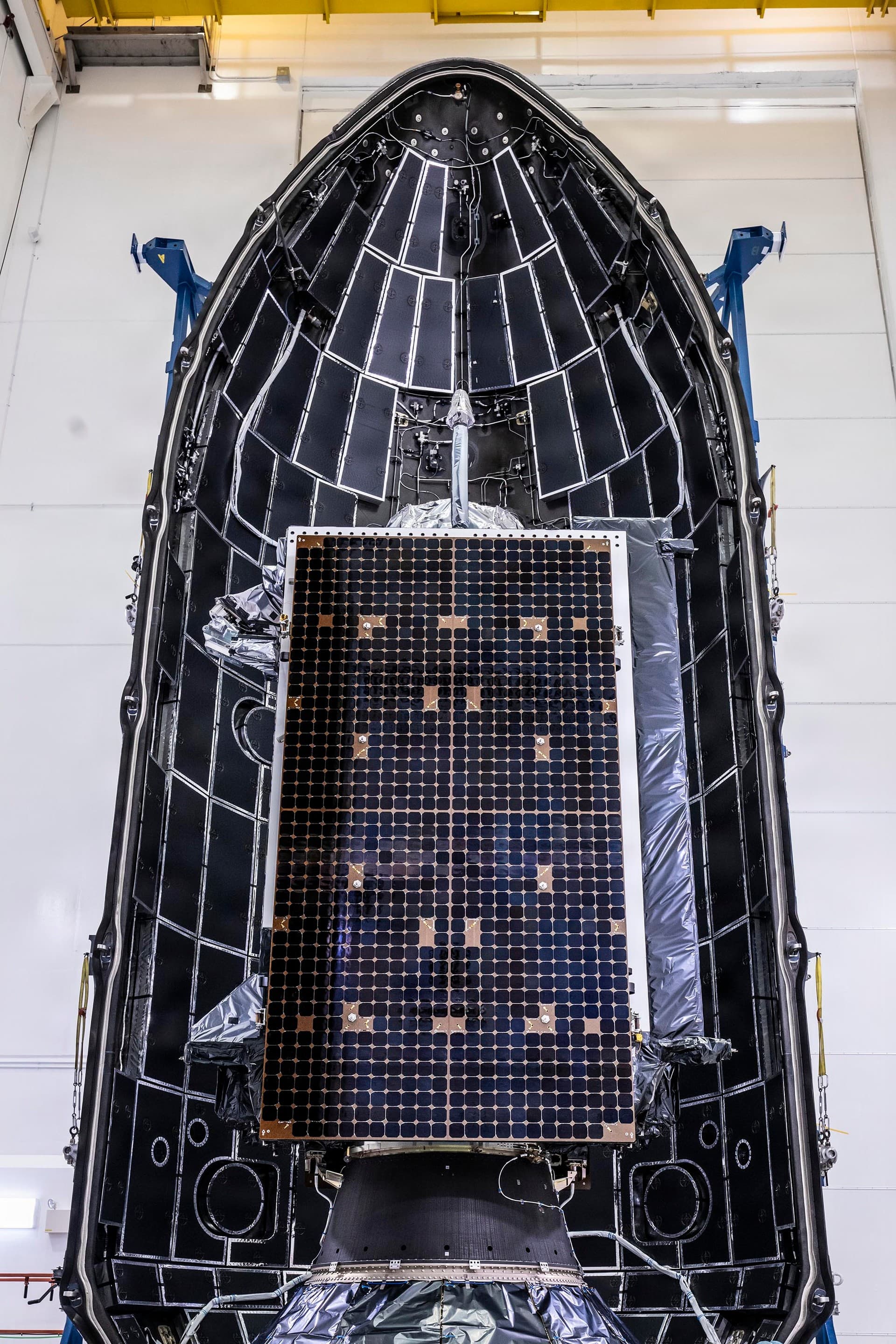
Oracle-Mobility (Oracle-M) is a highly mobile pathfinder satellite that will transit throughout cislunar space and experiment with techniques to maintain custody of objects in this region. Its mission will allow AFRL to assess strengths and weaknesses of navigation techniques needed for future operational systems. Oracle-M uses cloud-based ground operations with integrated government and contractor collaboration, and commercial ground systems rather than government-exclusive infrastructure—a cost-effective design choice. The propulsion system completed its hot fire test at Edwards Air Force Base on March 16–21, 2025. The satellite is manifested as a secondary payload on a National Security Space Launch mission. Air & Space Forces reported on October 29, 2026 that the Oracle program plans to launch its first satellite in December.
Oracle-Prime (Oracle-P) is the dedicated SSA experiment—designed to detect and track both known and unknown objects in cislunar space. AFRL describes it as building on Oracle-M's foundations as a dedicated SSA experiment, leveraging navigation techniques honed through Oracle-M and adding wide- and narrow-field sensors with on-board image processing to reduce downlink requirements. Advanced Space serves as prime contractor; Terran Orbital (a Lockheed Martin subsidiary) provides the spacecraft bus and Quantum Space the payload. Terran Orbital's bus completed its Preliminary Design Review in December 2025, with the milestone announced in April 2026. Delivery is targeted for 2027.
AFRL expects to use similar ground systems, satellite operations personnel, and data analysis pipelines for both programs, with data to be made available via the Unified Data Library. The architectural decision to use the same ground infrastructure for both missions means the navigation and custody tracking data Oracle-M generates will be interpretable alongside Oracle-P's SSA data, giving analysts a correlated picture of both what's moving in cislunar space and what works for tracking it.
The Cislunar Coordination Office and Cislunar Prime
The Space Force established its Cislunar Coordination Office in April 2026, announced at Space Symposium on April 16 by Maj. Gen. Stephen Purdy, the Program Executive Officer for Advanced Programs. The office is led by Jaime Stearns, who previously led AFRL's Oracle project and held strategic communications responsibilities at the Space Rapid Capabilities Office. The office is building a technology roadmap for cislunar space domain awareness, communications, and lunar navigation, and is working most closely with NASA—which owns the PNT and communications infrastructure—on those domains where civilian and military interests overlap.
SpaceWERX is leading Cislunar Prime, an investment initiative to accelerate commercial cislunar capability across space domain awareness, cislunar communications, and PNT. The initiative is structured as approximately 15 direct-to-Phase-II SBIR contracts at roughly $2 million each—a total envelope of around $30 million. AFRL plans to announce the initiative in December 2026, solicit proposals in January 2027, and begin awards in spring 2027.
Beyond Cislunar Prime, the Space Force and its Cislunar Coordination Office are pursuing additional procurement paths. As of late October 2026, the CCO had two forthcoming requests for information: one for existing cislunar hardware and software—including non-developmental satellites, sensors, and ground systems capable of flying within two to three years—and one reflecting Gen. Purdy's stated goal of fielding "a fully autonomous system out there at cislunar that's able to handle all its hardware faults, all its processing, all the sensor activities." An RFI for AI-driven autonomous processing capability is market research at this stage, not a requirement, but it marks where senior acquisition officials are pointing.
Then in early November, the Department of the Air Force issued a separate Cislunar Space System RFI (SAM.gov Notice ID 10302026-01, responses due November 24, 2026), reported by Air & Space Forces on November 2. The DAF is notionally interested in procuring up to five spacecraft as potential "seed vehicles" for a future proliferated cislunar constellation, with operations targeted for late CY29 and initial operations possibly by 2031. It plans up to five firm-fixed-price preliminary design study contracts and explicitly asks about AI and compute capability for long-duration autonomous operations. That framing—a proliferated constellation of autonomous vehicles operating at cislunar distances—makes the evaluation challenge below urgent rather than theoretical.
The evaluation problem acquisition leaders need to plan for
The hardest part of the Space Force's 2029 operational goal isn't the hardware. It's evaluating whether the AI-enabled autonomous systems proposed under these initiatives actually work.
For ground-based or LEO AI systems, test-and-evaluation typically involves running the system against a known dataset and comparing its outputs to ground truth. For a cislunar SSA or custody-tracking system, the ground-truth problem has two layers:
No historical catalog. AFRL notes that most existing satellite tracking sensors are designed to detect and track objects at GEO distances or closer. Without a comparable cislunar catalog, there is no independent reference against which to evaluate a tracking algorithm's accuracy. Oracle-M and Oracle-P are partly designed to generate that data. Until they do, claims like "95% tracking accuracy in cislunar space"—a hypothetical figure to illustrate the problem—cannot be independently verified against any operational baseline.
No operational network to test against. An AI system designed for autonomous cislunar maneuvering needs to be tested against the actual dynamics of the environment—the gravitational gradients, the communication outage profiles, the actual sensor noise characteristics at cislunar distances. Simulation can approximate these, but validation against simulation is not the same as validation against operational data.
This is not an unsolvable problem—it's the reason Oracle-M is a pathfinder rather than an operational system. AFRL's explicit intent is to generate the operational data that makes future evaluation tractable. But the implication for acquisition timelines is real: if Oracle-M launches in December 2026 as reported, programs targeting the Space Force's 2029 operational goal will have at most roughly two years of Oracle-M data to work with. Oracle-P plans a two-year on-orbit experiment after its projected 2027 delivery—meaning its data may still be accumulating when evaluation deadlines arrive. The constraint is data volume and coverage, not age alone.
A credible alternative to fully autonomous cislunar AI is a more conservative architecture: longer ground contact windows enabled by relay satellites, with autonomous systems limited to anomaly detection and emergency responses rather than routine tasking. That approach is technically simpler to evaluate but requires a relay constellation—cislunar communications is one of Cislunar Prime's three focus areas, though no operational relay architecture yet exists.
What acquisition teams should do now
Step 1: Map your program's autonomy requirements against cislunar latency. If your program's AI-enabled decisions need real-time comparison against a ground authority to function, you're designing for a relay network that doesn't exist yet. Know whether you're building for the emerging 2029 architecture or assuming a capability you should be advocating to procure separately.
Step 2: Track Oracle mission results as published benchmarks. AFRL expects to use similar ground systems, satellite operations personnel, and data analysis pipelines for both Oracle programs, with data to be made available via the Unified Data Library. Build a process to review those results as they become available—they will be the closest thing to an independent benchmark that cislunar evaluators have.
Step 3: Engage the Cislunar Coordination Office roadmap now. The Space Force's 2029 operational goal sounds distant; for space acquisition, it isn't. The coordination office is actively building technology roadmaps. Programs that engage early have more influence over what the roadmap prioritizes—communications infrastructure, sensor architecture, ground network design—and avoid designing toward a baseline that shifts after their requirements are locked.
Step 4: Evaluate AI autonomy proposals against their evaluation methodology. Cislunar Prime AI proposals that can demonstrate onboard decision-making verified against simulation with traceable audit logs and stated performance bounds—and that explicitly describe their validation approach against future Oracle data—are substantially better positioned than proposals that assert accuracy without a verifiable evaluation path.
Sources and further reading
- AFRL Oracle-M Hot Fire Test release — SSC and AFRL Public Affairs, May 7, 2025
- AFRL Oracle Family of Systems program page — AFRL
- Space Force establishes Cislunar Coordination Office — Air & Space Forces, April 22, 2026
- Space Force cislunar kit targets 2029 launch — Air & Space Forces, October 26, 2026
- AFRL plans to award $30M for Cislunar Project Starting Next Spring — Air & Space Forces, October 29, 2026
- Space Force weighs proliferated cislunar satellite constellation — Air & Space Forces, November 2, 2026
- DAF Cislunar Space System RFI (Notice ID 10302026-01) — SAM.gov, responses due November 24, 2026
- Terran Orbital spacecraft advances through PDR for Oracle-Prime — Terran Orbital, April 2026
- Advanced Space: AFRL cislunar mission progresses through key milestones — Advanced Space, April 20, 2026
—-
Arbiter, Spartan X's AI verification system in development, is designed for exactly this evaluation challenge: producing verifiable confidence in AI decisions in environments where real-time human oversight isn't operationally viable. The cislunar problem—evaluating autonomous systems against limited baseline data, before they operate beyond reliable ground contact—is the problem Arbiter's development is oriented toward. As the Space Force works to establish AI assurance methods for autonomous cislunar operations, Spartan X's work in this domain is directly relevant.