What IBCS changed in air and missile defense
Legacy U.S. Army air and missile defense operated through direct, point-to-point connections. A Patriot battery's command-and-launch element could only receive tracks from its own radar and could only task its own interceptors. Bringing in a second radar required a separate coordination step, which introduced latency and friction under a compressed engagement timeline. Integrating fires across battery and brigade boundaries required coordination above and beyond what a single node could automate.
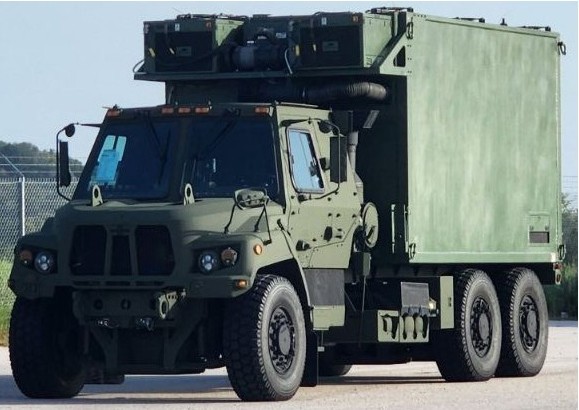
IBCS replaced that architecture with a software-defined Integrated Fire Control Network (IFCN). Under IBCS, a fire control node can receive track contributions from any networked sensor—Patriot's radar, the AN/TPS-80 G/ATOR ground radar, Sentinel, and in planned future increments, airborne and space-layer feeds—and can task the most appropriate available effector. The capability is real and demonstrated in Army training. IBCS batteries have successfully engaged targets using sensor data from platforms outside their own organic equipment, which was architecturally impossible before. Army description of the IBCS program and its multi-domain sensor integration.
The PEO Missiles and Space program office at Redstone Arsenal, Alabama manages the IBCS acquisition. The contractor is Northrop Grumman. The production decision followed multiple years of development testing, user evaluations, and a program reset that addressed hardware design issues identified during earlier evaluations.
The ATO problem for live-updating software
The most significant structural challenge IBCS exposed is one every AI-enabled C2 program will face: maintaining a valid Authority to Operate for software that needs to be updated continuously to remain effective.
DoD Instruction 8510.01 establishes the Risk Management Framework (RMF) that governs Authority to Operate decisions for all DoD information systems, including weapons systems with embedded software. The traditional model evaluates a defined software configuration, issues an ATO for that configuration, and requires reassessment when the configuration changes materially. For a traditional fixed-configuration system—a radar firmware release, a missile seeker software load—that model is workable. A new firmware release triggers a new evaluation; the pace of change is slow enough that the process can absorb it.
IBCS's IFCN software is different. The system's capability to integrate new sensors, address emerging threat signatures, and improve track correlation accuracy depends on the ability to update its software on operational timelines—weeks to months, not the annual cycles that traditional ATO reassessment assumes. When each meaningful software increment requires a re-evaluation of system security and safety properties, the program's ability to improve the capability is limited not by engineering but by process.
GAO's annual Weapon Systems Annual Assessment reports documented IBCS software integration stability as a recurring development concern, noting specifically that changes intended to address identified deficiencies introduced unexpected behavior in other interfaces, requiring additional test cycles. [GAO Weapon Systems Annual Assessment — annual series covering IBCS program status, available through gao.gov by searching "IBCS" within the assessment series]. Each such iteration meant retesting not just the changed component but the relevant inter-system interactions across the entire IFCN, compounding the cycle time.
The resolution path is continuous ATO (cATO)—an approach that establishes monitoring, automated testing, and risk-informed update authorization rather than full re-evaluation for each increment. The CDAO AI Adoption Strategy (November 2023) explicitly recommends cATO and DevSecOps integration for AI-enabled program acquisition, acknowledging that iterative update cycles are incompatible with traditional accreditation timelines. [CDAO AI Adoption Strategy, November 2023, available at ai.mil]. The critical operational point: cATO requires deliberate design. It cannot be retrofitted as an afterthought after the system is built. The authorization pathway, monitoring architecture, and update testing framework must appear in the initial acquisition strategy and system design.
Programs that assume they can resolve this problem during integration test will find themselves either delaying deployment to complete evaluations or fielding systems they cannot improve on the timelines that operational requirements demand.
Sensor data quality: what exercises typically hide
The second structural challenge IBCS surfaced is less visible in development testing but matters acutely in realistic operational environments: heterogeneous sensors contributing to the same fire control node do not produce equivalent track data.
When Patriot radar, G/ATOR, and Sentinel each independently detect the same airborne object, the resulting track reports may disagree on position, velocity, heading, and classification—not because any sensor is malfunctioning, but because each platform is optimized for a different detection geometry and fidelity trade-off. Patriot's radar is optimized for engagement-quality fire control; G/ATOR is a longer-range surveillance radar with different resolution characteristics; Sentinel is a forward-area air defense radar with its own sensitivity profile. Their track outputs cannot be treated as interchangeable.
IBCS's fire control software must correlate those tracks into a single combined air picture under the latency constraints of an actual engagement timeline. The correlation algorithm—an AI-enabled data fusion function—makes association decisions under uncertainty: is track A from Patriot the same object as track B from G/ATOR, or two different objects? In exercises, this question is usually straightforward because scenarios are designed with known objects on predictable paths. In a contested environment with electronic attack, spoofed or degraded sensor inputs, and multiple simultaneous threats, the hard correlation cases accumulate precisely when the engagement timeline is most compressed.
The practical implication for program offices and contractors: the sensor data quality characterization of each contributing platform is a necessary design input, not a post-delivery concern. Understanding the track error envelope of each sensor—its position uncertainty, its classification confidence range, its behavior under EW—is prerequisite knowledge for designing reliable correlation logic. That characterization typically does not appear in any single sensor's system specification because each sensor was procured separately. Acquiring it requires deliberate multi-sensor integration testing planned and funded as a distinct line item. Programs that skip this step will encounter it during operational evaluation, where the cost is measured in schedule months rather than testing weeks.
What IBCS integration surfaces about JADC2 requirements
IBCS is not just an air defense story. It is the Army's most operationally deployed reference implementation of what JADC2 requires at the unit level: software-defined networking between sensors and effectors, with AI-enabled fire control mediating the connection. DoD's JADC2 Implementation Plan, published in March 2022, establishes the enterprise framework; IBCS provides a fielded example of what realizing that framework in a specific mission area required. [DoD JADC2 Implementation Plan, March 2022, available through media.defense.gov].
Three architecture requirements that IBCS surfaced have applicability beyond air defense:
Latency is mission-function specific. The acceptable latency for passing an intelligence update to a commander differs from the latency acceptable for commanding an interceptor away from a target. Systems that use a single data transport layer across all message types—a simplifying assumption that is common in early architecture design—will discover that some functions are degraded at network conditions where others perform acceptably. Mission-specific Quality of Service design must be part of the initial architecture, not a performance optimization after fielding.
Resilient operation is a baseline requirement, not a feature. IBCS must function—at reduced capability—when communications links are degraded. In contested environments, the assumption of reliable connectivity is a known adversary target. Systems that behave reasonably under normal conditions but fail hard under degraded connectivity have limited value in the environments where integrated fire control matters most. The design requirement is graceful degradation: the system must identify which functions it can continue to perform on the available network capacity and maintain those, rather than requiring the full designed capacity to operate at all.
The human-machine interface for correlation uncertainty is an operational design problem. When the track fusion engine's confidence in a correlation decision falls below a threshold, an operator must make or confirm the decision. What the system presents to that operator—which information is available, how confidence is communicated, what options are actionable, how the decision is recorded—determines whether the system makes the operator more accurate under stress or more confused. This interface is not a UX addition. It is a determinant of whether the system delivers its claimed operational value. It requires deliberate design, realistic test scenarios, and training that includes the degraded cases, not just the nominal ones.
Decisions program offices and contractors face today
The IBCS experience produces four specific design choices that affect schedule, cost, and operational outcome for any similar program.
Establish the cATO pathway before writing the SOW. The authorization process for a live-updating AI system is a program architecture decision. If the acquisition strategy does not include a DevSecOps framework and a defined cATO approach from the start, the program will encounter the IBCS ATO cycle problem when software maturity demands updates. The CDAO AI Adoption Strategy provides the policy basis; the program office must translate that into executable contract language.
Budget sensor characterization as an independent line item. The cost of understanding each contributing sensor's track error envelope under realistic conditions is knowable in advance and modest compared to the cost of discovering it during operational evaluation. A deliberate integration test plan that characterizes sensor agreement and disagreement across the relevant engagement geometries is a recoverable investment. Discovering the same information during operational test is not.
Define degraded-mode behavior before building the high-performance case. Programs under schedule and cost pressure tend to prioritize demonstrating peak performance in the designed scenario and defer resilience design to later increments. For a system whose operational value depends on functioning in contested conditions, this sequence is backward. Define what the system must do at 60 percent network capacity, with one contributing sensor offline, under active electronic attack. Those requirements will drive architecture decisions that are difficult to retrofit after the core system is built.
Treat operator interfaces for uncertainty as requirements, not design options. The interface through which an operator interacts with the system's confidence outputs—what they see, what they can act on, what is recorded—is a documented requirement that the system must meet. If it is treated as a design option left to the contractor's discretion, the delivered interface will optimize for nominal operation rather than the degraded cases where operator judgment matters most.
What would change the analysis
These recommendations apply to the baseline case for any AI-enabled multi-sensor command node. Three conditions would change the weight or applicability of specific items.
If a program operates only in fully permissive environments with reliable communications and no electromagnetic threat, the resilience requirements simplify substantially. The question is whether that operational profile is realistic for the intended deployment context.
If a program connects a single sensor type to a single effector type, the track correlation problem disappears. The ATO and cATO requirements still apply to the software integration layer, but the multi-sensor data quality problem is not relevant.
If the AI component operates in read-only advisory mode—providing decision support to an operator who retains full manual override—rather than taking automated fire control action, the ATO requirements for live-updating software are somewhat less stringent than for systems that act without operator confirmation. This is a deliberate architecture choice with significant schedule implications in either direction.
Sources and further reading
- Army News Service reporting on IBCS Initial Operational Capability (2023) — available through army.mil by searching "IBCS IOC"; the announcement covers the initial fielded battery and program status at IOC
- GAO Weapon Systems Annual Assessment series — annual reports document IBCS program status and development risk findings; search "IBCS" within the series for the relevant years
- PEO Missiles and Space IBCS program information — official program description and contractor information
- CDAO AI Adoption Strategy (November 2023) — policy basis for cATO, DevSecOps, and AI-enabled system authorization frameworks
- DoD Instruction 8510.01, Risk Management Framework for DoD Information Technology — the governing instruction for ATO requirements applicable to all DoD IT including AI-enabled systems; current version available through dod.gov
- DoD JADC2 Implementation Plan (March 2022) — establishes the enterprise C2 integration framework that IBCS-class programs contribute to
Spartan X works on the AI integration problems that IBCS-class programs face at the edge: multi-model verification and consensus for AI systems that must operate reliably under sensor disagreement, AI infrastructure designed for DDIL environments where resilience is a baseline requirement rather than a performance enhancement, and the assurance architecture that connects operational AI performance to the authorization decisions that determine whether those systems can deploy. The structural constraints IBCS surfaced are the same constraints that edge AI and C2 infrastructure must resolve for programs across all domains.